By Aaron Allen, The Seattle Medium
Despite decades of displacement from Seattle’s Central District, many Black community leaders believe the community has retained something just as important as geography: its ability to stay connected.
For former Washington State Rep. Dawn Mason, that enduring connection can be summed up in a simple phrase.
“We know how to get home.”
Those six words capture a reality that has sustained Seattle’s African American community through decades of demographic change, economic upheaval and displacement.
Once the unquestioned cultural and residential heart of Black Seattle, the Central District has undergone a dramatic transformation. As housing costs soared and development accelerated, thousands of Black families were pushed farther south and farther north into communities throughout the Puget Sound region. The neighborhood that once served as the center of Black life in Seattle no longer reflects the demographics that defined it for generations.
Yet despite that dispersal, the community has refused to disappear.
Instead, many leaders, institutions and organizations are embracing a concept increasingly referred to as cultural sovereignty, the ability of a community to define, protect and sustain its cultural identity, heritage, institutions and collective memory regardless of external pressures.
In Seattle, cultural sovereignty has evolved from an academic concept into a practical strategy for survival.
To understand why the idea has become increasingly important, one must understand what was lost. For much of the 20th century, racist redlining policies confined Black residents to Seattle’s Central District. Out of those restrictions emerged a thriving ecosystem of Black-owned businesses, churches, civic organizations, cultural institutions and neighborhood relationships that became the foundation of Seattle’s African American community.
As gentrification accelerated in recent decades, that physical infrastructure began to erode.
“The fabric of Black cultural production in the Black community … is disintegrating,” said Anthony Tibbs, a longtime cultural organizer in Seattle’s African American community. “We are at a point in history where we have to adapt to rapid changes, transforming things we did naturally into smart strategies to keep our community anchored.”
For Mason, however, the story is not solely one of loss.
She believes the ability to remain connected despite geographic separation is deeply rooted in the historical experiences of African Americans.
“There is something within our nature that we always find each other,” Mason said. “We’ve been dispersed, dismissed and moved around since the plantations and the end of enslavement, yet we still stay together. It’s part of our culture. Technology has changed how we stay connected today, but our determination to define that cultural connection ourselves, rather than letting oppressor groups define it for us, is what keeps us surviving.”
That resilience is increasingly reflected in efforts to build and preserve Black-controlled institutions designed to serve both present and future generations.
Projects such as the Liberty Bank Building, the William Grose Center for Enterprise and Africatown Plaza represent more than affordable housing or economic development initiatives. Together, they represent efforts to reclaim space, preserve history and create opportunities for Black families and entrepreneurs to remain connected to the communities they helped build.
The Liberty Bank Building sits on the site of the Pacific Northwest’s first Black-owned bank. The William Grose Center for Enterprise honors one of Seattle’s earliest Black pioneers while creating opportunities for entrepreneurship and technology education. Africatown Plaza, a 126-unit affordable housing development designed and built with significant Black leadership, represents a modern effort to bring displaced residents back into the Central District.
These projects reflect a broader understanding that cultural preservation and economic development are inseparable.
Churches, community centers, cultural institutions and Black-owned businesses also continue to play a vital role in maintaining community cohesion. While physical gathering places may have diminished, they remain important anchors for a population now spread throughout the region.
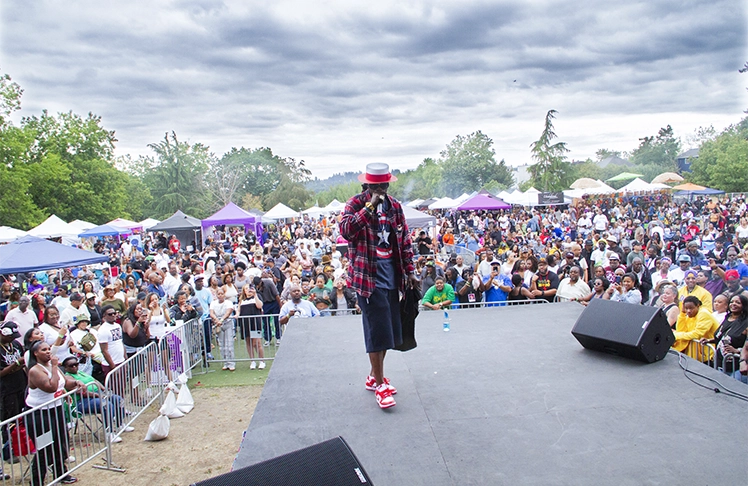
Community celebrations and cultural gatherings continue to serve a similar purpose. Annual traditions such as Umoja Fest, Juneteenth celebrations and other community events create opportunities for families, entrepreneurs, artists and residents to reconnect, strengthen relationships and pass cultural knowledge from one generation to the next.
According to Tibbs, those gatherings serve a purpose far beyond entertainment.
“Festivals and gathering spaces present safe havens for Black people to collectively gather and continue to provide avenues for Black business, civil and health agendas to continue to impact our people,” Tibbs said.
For many community leaders, cultural sovereignty is ultimately about much more than physical space. It is about ensuring that a community retains the ability to tell its own story, define its own identity and shape its own future.
“Cultural sovereignty is the inherent right of a community to define, control, celebrate and preserve its own heritage, narratives and economic destiny, independent of external societal pressures or systemic displacement,” Tibbs said.
That principle becomes especially important when considering future generations.
For Mason, cultural sovereignty is ultimately about what happens next.
“How are we going to pass our batons to the next generation?” Mason asked. “How are we gonna light their candles from ours if we don’t bring ourselves together? If our children don’t see the adults planning, showing what makes us happy, interacting positively and showcasing how we entertain ourselves, then they may grow up thinking all we have is trauma. But we don’t.”
In a city transformed by growth, development and displacement, that may be the true measure of cultural sovereignty: not whether a community can preserve every block or building, but whether it can preserve the relationships, traditions and collective memory that allow future generations to find their way home.