By Kiara Doyal, The Seattle Medium
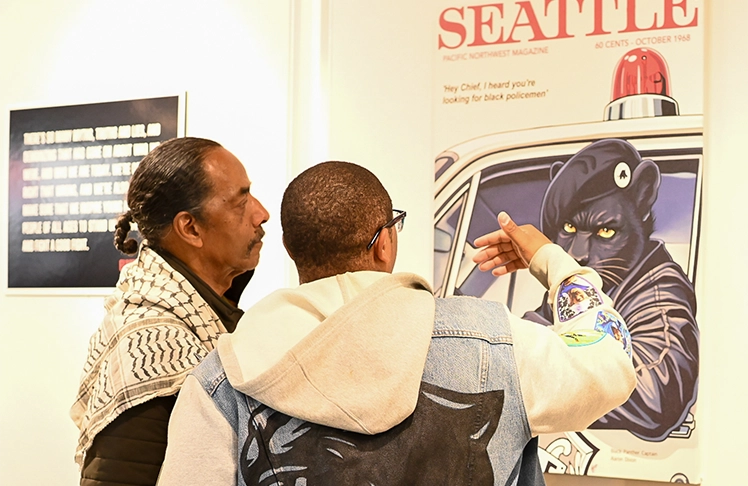
ARTE NOIR’s Central District Legacy: Black. Power. Black Panthers., now on view through Aug. 2, explores the history, cultural influence, and enduring legacy of Seattle’s Black Panther Party through visual art, community memory, and the lived experiences that shaped the Central District.
Rooted in history and cultural power, the exhibition celebrates the impact of the Black Panther Party in Seattle while recognizing the Central District as a vital center of Black life, culture, and resilience.
As the first Black Panther Party chapter established outside California, the Seattle chapter, founded in spring 1968, worked to protect, preserve, activate, and sustain revolutionary resolve in pursuit of resources, dignity, and self-determination for Black communities. The chapter remained active until 1978, leaving an imprint that continues to shape civic life, cultural memory, and community care in Seattle and beyond.
“There are so many myths, truths, lies, and demonizing that have gone on about who we were, and who we are today,” said Elmer Dixon, co-founder of the Seattle chapter of the Black Panther Party. “We’re going to right that wrong, and we’re also going to make sure that we inspire the young people and people of all ages to stand up for freedom and fight a good fight.”
Created by a coalition of Seattle activists, the Seattle Black Panther Party advanced community justice efforts and built models of mutual aid that raised political consciousness throughout the Central District.
The exhibition reflects that legacy through works that explore Black identity, collective power, activism, and community care while inviting visitors to engage with the history and cultural significance of the Black Panthers in Seattle.
Featured artists include Achille “AJ” Barbel, Jonathan Brickous, Charles Connor, Tasannee Durrett, Serron Green, Thaddeus Hunnicutt, Tafy LaPlanche, Crystal Noir, and Ed-Lamarr Petion.
Collectively, the works present visual narratives centered on youth solidarity, activism, the symbolism of the raised Black Power fist, the vibrancy of color, and the panther itself, an enduring symbol of protection, strength, and Black identity.
For ARTE NOIR Curatorial Manager Hassan Kirkland, the exhibition extends beyond art into broader conversations about culture, memory, and community.
“The inspiration behind the exhibit was to capture the depth from blackness as a cultural moniker related to the Black community, the element of power, and its diversity of what power can connote,” said Kirkland. “Because we can find power not so much just in direct examples like the Black Panther Party, but the power of community, the power of church, the power of education, the power of Black businesses, and the power of just knowing that your history came from a legacy.”
Kirkland said education is central to the exhibition experience, which incorporates voices, reflections, and lived experiences alongside the visual works to deepen visitors’ understanding of the history being presented.
“The voices offer a different form of learning or education, because it invokes a kind of oratorical, kind of historically African method of griot, which is usually an elder or teacher or some form of position of a person who has historical knowledge, sharing by word,” said Kirkland. “So, when you’re reading some of the texts in the space, you’re getting this kind of symbolic narrative of this elder or this real individual that’s sharing with their lived experience and what they observed, and how we can digest that in this current state.”
Kirkland said the exhibition also highlights the cultural vibrancy and creative expression rooted in the Central District.
“The work that is there, they hold a certain element of blackness due to the context and cultural narratives that are provided,” said Kirkland. “Education is wrapped into it, culture is wrapped into it, expression and creativity are wrapped into it, and that’s a part of the vibrancy that comes from the Central District legacy that we’re trying to showcase and capture in this particular exhibit.”
For those who attend, Kirkland hopes visitors leave with a stronger sense of community and historical context, understanding that if the community could endure what it faced in the past, it can continue moving forward and overcoming future challenges. The goal, he said, is to recognize and honor the power, Black identity, and collective strength within the community.
“I hope that they take away the gems from the voices that have been shared about those kinds of reflective years. I hope they take away just the encouragement and inspiration of what creativity and visual art can provide, as far as ideas and the imagination for the younger generations who may come and see the show,” said Kirkland. “Within this particular gallery, we are showcasing Black vibrancy, so that you can walk away knowing that even though the exhibit may come down, this history is in your community, and while the exhibit is up, you can come here learn, celebrate, and become educated even more as you pursue through your own life.”