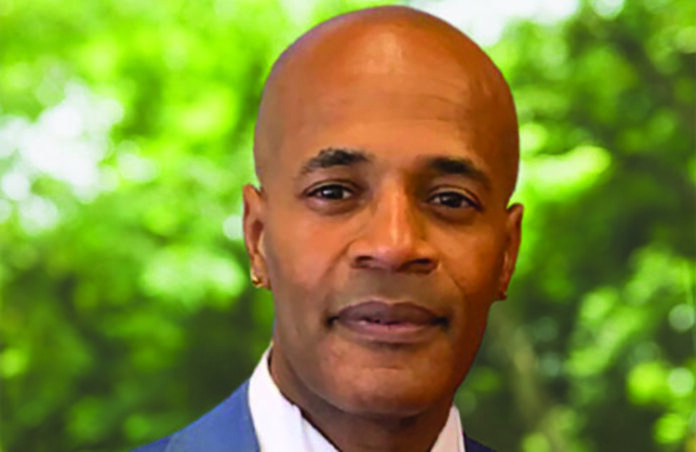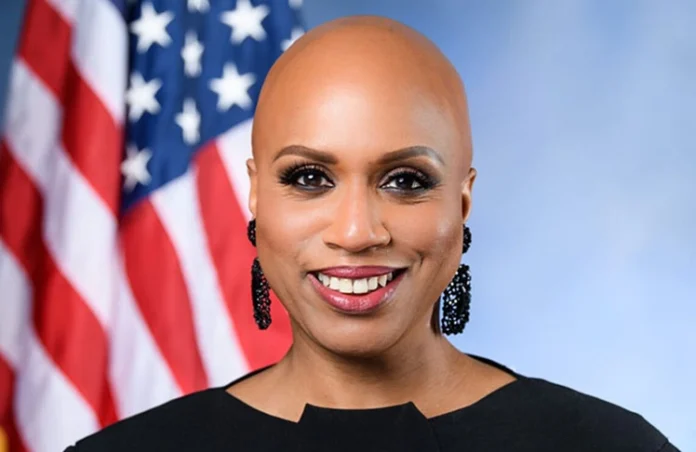
A new report from Washington state reveals a pervasive issue of workplace harm affecting Black women. Conducted by the Washington State Women’s Commission and Blacks United in Leadership & Diversity, the survey found that nearly every Black woman reported experiencing microaggressions, exclusion, and barriers to advancement, despite their qualifications and commitment to public service. This finding emerges amidst a period where over 300,000 Black women nationwide have lost their jobs, often coinciding with the rollback of diversity, equity, and inclusion initiatives. Ayanna Colman, Chief Human Resources Officer for the Office of Administrative Hearings, shares more about the report on this episode of the Rythm & News Podcast.
A construction crane is seen above the White House on April 28. (Anna Moneymaker/Getty Images via CNN Newsource)
By Eric Bradner, CNN
(CNN) — Forty-five years before a gunman attempted to storm the Washington Hilton’s ballroom during President Donald Trump’s appearance at the White House Correspondents’ Dinner, another would-be assassin stood on the sidewalk and shot President Ronald Reagan in the chest as he exited the same hotel.
The location, and the presence of a Republican president, is likely to be where the comparison ends.
In 1981, gunman John Hinckley Jr. also shot White House press secretary James Brady, leaving him partially paralyzed. Brady would go on to become a leading gun control advocate — and the namesake of 1993’s Brady Handgun Violence Prevention Act, which introduced mandatory background checks and waiting periods for handgun purchases. It was backed by Reagan, who publicly supported the measure in a 1991 speech despite being a lifelong National Rifle Association member.
Today, the gun control debate is likely to remain in neutral, even after a shooting near the ballroom where Trump, Vice President JD Vance and many of the nation’s top leaders were dining with the Washington press corps. The GOP remains entrenched, younger generations who have fought unsuccessfully for new restrictions for years are frustrated and the solution generating the most discussion is a more secure ballroom for the nation’s elite.
The gunfire Saturday night occurred in a much different political climate — after decades of failed attempts to ban assault rifles and high-capacity magazines, expand background checks on gun purchases and more following mass shootings. Those efforts have been championed largely by Democrats and mostly opposed by Republicans.
“This isn’t about, in my mind, changing the law or making the laws more restrictive around possession of firearms,” Acting Attorney General Todd Blanche said in an interview earlier this week with CBS. “This is about law enforcement who are doing their jobs and a suspect who tried to do something and failed miserably.”
Blanche on Wednesday stood with gun industry leaders as he announced the Justice Department would seek to further roll back gun control measures, proposing a slew of new rules aimed at helping gun sellers more easily abide by the law. Blanche said the administration is “cutting unnecessary red tape, and we are replacing confusion with clear, straightforward language so that everyday Americans don’t need a law degree just to understand their rights.”
Entrenched positions in gun debate
Kris Brown, the president of Brady, the gun violence prevention organization the former press secretary helped to found, said in an interview that parents across the United States fear that their children “are going to a White House Correspondents’ Dinner every day when they go to school” because of those legislative failures.
Brown argued that “even in challenging circumstances, something can always be done.”
“If you look at every major federal gun law that has passed in America, it’s passed on the heels of horrific violence — and in some cases, against elected officials,” she said.
In 2022, Congress approved the first major gun safety measure in nearly 30 years with the Bipartisan Safer Communities Act, which passed in the wake of mass shootings in Uvalde, Texas, and Buffalo, New York. It expanded background checks for gun buyers under age 21 and closed the so-called “boyfriend loophole” that restricts firearms purchases for those convicted of domestic abuse.
But Brown also said she is not “naive about the politics in place at the moment,” and contrasted Reagan’s support for Brady’s gun control push with Trump’s calls for a White House ballroom.
“It also does take leadership,” she said,
John Commerford, the executive director of the National Rifle Association’s Institute for Legislative Action, maintained in an interview that gun restrictions are not the solution.
The accused gunman was armed with a .38-caliber semi-automatic pistol and a 12-gauge shotgun, authorities told CNN – firearms that have not been targeted by recent legislative efforts to restrict the sale of semi-automatic rifles with high-capacity magazines.
Commerford noted that, according to officials, the alleged shooter traveled by train to Washington from California – two deep-blue jurisdictions.
“This individual lived in California, acquired firearms under their extremely restrictive standard, traveled to Washington, DC, which has very similar, extremely strict gun control, and then was stopped by what I would call adequate security measures,” he said, praising the Secret Service’s actions.
“Their layer of security worked. Watching the videos, was it pretty? No. But real time isn’t pretty,” Commerford added. “Everyone went home safe or is able to recover.”
He noted that some mass murderers have carried out their plans without firearms — pointing to the 2025 New Year’s Day attack in New Orleans in which a man drove a pickup truck through a crowd on Bourbon Street and killed 14 people.
“An individual hellbent on committing harm is going to find a way to commit harm,” he said.
A fight over ballroom
There were few new conversations about ways to prevent gun violence following Saturday’s gunfire.
Instead, this week in Washington, a debate erupted over Trump’s proposal to build an ultra-secure White House ballroom, where bullets couldn’t pierce windows and the Secret Service would handle security.
The National Trust for Historic Preservation in December sued to block construction of the ballroom. A federal appeals court this month gave the Trump administration the green light to continue construction of what the president has said will be a ballroom that holds 999 people, overturning a lower court that had blocked the above-ground construction of the project. (Roughly 2,600 people attended Saturday’s dinner.)
House Speaker Mike Johnson told reporters Monday that “obviously we do need to look at security measures.”
“This is why we need the ballroom. It really is. The president’s right about that. We need a facility that is secure enough to host events like this without having major national security concerns,” the Louisiana Republican said.
House Minority Leader Hakeem Jeffries of New York called Trump’s proposed ballroom a “vanity project” and sought to turn attention to the war with Iran.
“I mean, there’s obviously a lot of questions about how much it costs, how many people will be accommodated,” the Senate’s No. 2 Democrat, Dick Durbin of Illinois, said of the ballroom.
Trump administration officials and Republicans who control the House and Senate indicated no new appetite for laws aimed at reducing the threat of gun violence.
Secretary of State Marco Rubio said Monday on Fox News that one individual disrupting “what is one of the bigger nights in Washington, especially when the president attends” is “kind of the world we live in right now.”

Generational differences
When the shooting took place Saturday night, some observers noted that younger attendees in the Washington Hilton’s ballroom — people who had grown up with school shooting drills — quickly ducked under tables.
The response by young attendees at the dinner in the moment was “not surprising,” said Jaclyn Corin, the executive director of March For Our Lives — the pro-gun control group founded in the wake of the 2018 mass shooting at a high school in Parkland, Florida, where Corin was a student.
“A lot of young people are forced to live with this alertness, and so when something actually does happen, their instincts take over, and they know what to do,” she said. “And I interpret that as adaptation to a reality that should not exist.”
Polls in recent years have found about three-in-five Americans support stricter gun laws — and young Americans are largely in line with the overall population. A 2023 poll of 18- to 29-year-olds by the Institute of Politics at Harvard Kennedy School found that 63% support stricter gun laws. It also found that 40% said they worried about falling victim to gun violence.
Mass shootings such as the 2012 killing of 26 people at Sandy Hook Elementary School and the 2018 slaying of 17 at a Parkland high school have been followed by campaigns for federal gun control measures, but those have largely failed despite the lobbying efforts of groups like March For Our Lives.
While the 1981 Reagan assassination attempt was a “understood by everyone as a complete shock and something that demanded a response,” what unfolded at Saturday’s dinner “was just another day of grim recognition of a pattern and not surprise at all,” Corin said.
“Today, we are living through a pattern that is both more frequent and also more lethal, and yet our political system has become more capable of absorbing these moments without consequence,” she said.
A visitor captures a cell phone image of the Washington Monument, near the US Capitol on September 29, 2021. (Tom Brenner/Reuters/File via CNN Newsource)
By Annie Grayer, Ellis Kim, CNN
(CNN) — Congress has approved another short-term extension of controversial spy powers that permit US officials to monitor phone calls and text messages from foreign targets.
The deadline to renew the powerful surveillance law exposed deep divisions in the Republican Party and left US national security officials scrambling as they sought to blunt the potential for blind spots in intelligence collection.
For months, Republicans on Capitol Hill have searched for a path forward to reauthorize the legislation – which the short-term extension now only prolongs.
The law, Section 702 of the Foreign Intelligence Surveillance Act (FISA), allows authorized US officials to gather phone calls and text messages of foreign targets, but can also scoop up the data of Americans in the process.
Here’s what to know as lawmakers again kept the program going under the pressure of a midnight deadline.
How long has the law been extended?
The surveillance law is in effect for another 45 days – but it’s only a temporary patch.
The Senate passed the short-term extension after the House earlier in the week passed its own, more contentious version of the measure. Ultimately, the House passed the Senate’s extension in a 261-111 vote to avert a lapse.
That stopgap was needed, Senate Majority Leader John Thune suggested, because the Senate was unwilling to pass the House’s bill after conservatives in the chamber got an unrelated crypto measure attached to it.
How does the government use FISA?
Under updates to the FISA law enacted in 2008, the government has the ability to compel US phone companies and internet providers to provide access to communications across the “backbone” of the internet. The government can also compel access to phone information that can allow it to obtain the content of calls and also require email providers and others to provide communications from a specific address.
And according to a September 2023 public oversight report by the Privacy and Civil Liberties Oversight Board – which was formed to periodically assess the program – in addition to the above methods of collecting data, the board refers to an additional “highly sensitive technique” that was only authorized in 2022.
The trove of data, including a large portion of US internet traffic, is meant to provide US intelligence agencies with quick access to data regarding foreigners in other countries.
As CNN has reported, a good portion what what appears in the Presidential Daily Brief has some data that comes from the 702 program, according to the National Security Agency.
What’s at risk if it expires?
It depends who you ask.
Senior national security officials have for years said Section 702 is critical to thwarting terror attacks, stemming the flow of fentanyl into the US and stopping ransomware attacks on critical infrastructure.
The authority is now more critical than ever, officials say, amid the delicate ceasefire in the US war with Iran and a heightened threat environment.
Civil liberties groups on the left and the right, meanwhile, argue the surveillance authority risks infringing on Americans’ privacy. The program is currently warrantless, in large part because it is aimed at foreigners not Americans, but US citizens do get swept up in the surveillance when they are interacting with targets abroad.
The law, which verged on expiration multiple times in recent months, became embroiled in the broader Republican battle over the reach of the government’s surveillance powers.
And some Democrats who have previously supported the spy program expressed concern over renewing it under a Trump administration that they do not trust, making the margins Republicans have to rely on even smaller.
At first, the Trump administration did not weigh in on how they wanted Republican lawmakers to handle the renewal of the law, allowing divisions to build and fester. The president and his supporters have previously conflated the law with other legal methods used to investigate Russian interference in US elections and allegations that people associated with the Trump campaign in 2016 were connected to those Russian efforts.
But earlier this month, President Donald Trump called for a clean reauthorization of the law for 18 months. That did not sway conservative Republicans who have insisted that the bill include reforms like warrants before querying Americans’ communications.
This headline and story has been updated with additional developments.
The US Supreme Court building on April 29. (Nathan Howard/Reuters via CNN Newsource)
By Tierney Sneed, Fredreka Schouten, John Fritze, CNN
(CNN) — A day after the Supreme Court further gutted the Voting Rights Act, Republican-led states are eying changes to boost the GOP’s gerrymandering effort at the expense of voters of color, while voting rights groups are trying to limit the impact of the ruling on this year’s midterms.
The Supreme Court kicked off the scramble by throwing out a Louisiana congressional map that had two Black-majority districts in an opinion that will make it significantly harder to challenge redistricting plans as discriminatory under the Voting Rights Act.

Leaders of Louisiana’s Republican-controlled legislature said they are preparing to draw a new congressional map to be used for November’s midterms, even as ballots have already put been in the mail for the May 16 primary. GOP officials said they won’t count the votes for US House candidates in the primary.
In Tennessee, top Republican officials faced growing public calls to launch a special legislative session with the goal of removing the state’s only Democratic congressman. Right-wing pressure for redistricting is also building in other states, including Georgia, South Carolina and Alabama.
Meanwhile, a group of Black voters who were defending Louisiana’s current congressional map cautioned the Supreme Court on Thursday against allowing the state to rush into a hasty redistricting based on the court’s decision.
“The governor has already indicated that he intends to cancel the ongoing Republican and Democratic primary elections in which voters have already cast ballots and on which candidates have already heavily expended their money, time, and resources,” the Black voters who were defending the maps told the Supreme Court, while citing past orders from the justices urging courts to be wary of disrupting election planning with last-minute moves.
“Such a drastic action,” the voters said, “is unnecessary and unwarranted.”
Florida Republican Gov. Ron DeSantis on Wednesday was able to use the Supreme Court’s ruling to help get a congressional plan passed in that state that aims to turn four blue House seats red, after facing leeriness by both the state legislature and the congressional delegation.
Once the legislature passes a new redistricting plan, “it’s the starting line, not the finishing line,” for the officials who need to hurriedly rework their plans for administering the election, said David Becker, a former Justice Department voting attorney who now advises election officials.
That could include verifying that millions of voters are properly coded for their new districts and restarting the candidate qualification process.
The current tussling comes after President Donald Trump already injected enormous chaos into this electoral cycle by convincing Texas to embark on an unprecedented round of mid-decade redistricting – a move that started a gerrymandering arms race between Republicans and Democrats.
“In the partisan war that we are facing that the Supreme Court just inflamed, the parties caught in the middle are the election officials and the voters,” Becker said, “They’re not going to be any winners here.”
Trump join pressure campaign against longtime critic
The seat of Memphis-area US Rep. Steve Cohen, the sole Democrat in Tennessee’s congressional delegation and a major Trump critic, is now at risk with state lawmakers feeling the squeeze to draw him out of the district before an August primary.
In a social media post Thursday, Trump said he had spoken to the state’s GOP Gov. Bill Lee. Lee, he said, has pledged to “work hard to correct the unconstitutional flaw” in the state’s US House map. The president said other political leaders in the state also have agreed to take action.
A Lee spokesperson did not immediately respond to CNN’s inquiry. In a statement, Tennessee House Speaker Cameron Sexton said: “We are reviewing the recent opinion as I have conversations with the White House and other individuals.”
Under Tennessee law, the governor or the majority of members in both chambers of the state’s General Assembly would have to call the legislature back into a special session to redraw the House map.
Attempts to slow-roll Louisiana’s rush to redraw a Black Democrat’s House seat
Now pending before the Supreme Court is a technical but potentially meaningful procedural question about how quickly that ruling will take effect in Louisiana.
The group of White voters who challenged the second Black district filed an emergency request late Wednesday urging the court to make its decision final immediately, rather than waiting the month it would normally take to formally send the case back to a lower court for action.
But the voting rights group who lost the case told the justices on Thursday that there is “no urgency” for the Supreme Court to implement its decision and warned that doing so would cause confusion during an election that is already underway. It urged the court to hold off on taking further action until the election is over.
The appeal over timing is pending before Justice Samuel Alito, who handles emergency cases rising from Louisiana, Texas and other states covered by the 5th US Circuit Court of Appeals. It was also Alito who authored the 6-3 opinion striking down the state’s map.
Alito’s opinion Wednesday included no guidance on what should happen next in the case. In 2024, the Supreme Court blocked a lower court ruling striking down the state’s map. Either Alito or the broader court will have to decide whether that two-year-old order remains in effect or was effectively lifted by the Supreme Court’s decision on Wednesday.
Louisiana Rep. Cleo Fields, the Democrat whose district is at the center of the voting rights opinion, decried the move by state Republicans to suspend the primary.
“People are already voting,” Fields told CNN. “It adds insult to injury to come and say, ‘Your vote won’t be counted. We’re just going to change the districts. We’re going to stop the election.’”
A case over Mississippi’s judicial lines poses an early legal test
An early test to the Supreme Court ruling’s impact will be in Mississippi, where Black voters brought a successful Voting Rights Act challenge to the electoral boundaries for state supreme court seats. Proceedings in that case were under way this week to determine how a new judicial map should be drawn.
Senior District Judge Sharion Aycock has asked for additional briefs due next week on how the Supreme Court ruling affects the case.
An open question that election law scholars have been debating since the Supreme Court’s ruling is how it will apply in non-partisan elections.
Alito’s opinion sets up partisan gerrymandering as a defense that states can use to ward off VRA challenges. But because Mississippi’s judicial elections are non-partisan, that case could show how the new standard will work in non-partisan elections, which are common for local elected bodies.
Even before the ruling had come down, Republican Mississippi Gov. Tate Reeves had told lawmakers he’d call a special legislative session to address how the Supreme Court’s opinion affects the judicial plan.
Ships are pictured anchored near the shoreline in Bandar Abbas, Iran last month. (Stringer/Getty Images via CNN Newsource)
By Nic Robertson, Jessie Yeung, CNN
Islamabad, Pakistan (CNN) — As the stalemate between Washington and Tehran drags on and the world waits in hope of a deal, the very real possibility of an alternate outcome – the resumption of war – looms overhead.
The clock is ticking, with Friday as the anticipated deadline for Pakistan to receive Iran’s revised peace proposal, after US President Donald Trump rejected a previous version.
Mediators in Islamabad believe a fair deal is within reach and that it is now down to Tehran to respond to it, according to sources familiar with the process. They’ve been working tirelessly to get an agreement, but as they have waited for most of this week for that reply, the US and Iran have doubled down on their threats and taunts.
As recently as Wednesday – the earliest day Tehran was expected to respond – Trump posted a mocked-up image of himself holding a gun on Truth Social, telling Iranian leaders to “get their act together.”
“No more Mr. Nice Guy,” read the caption.
Later, from the Oval Office, Trump added: “At this moment, there will never be a deal unless they agree that there will be no nuclear weapons.”
But Iran has pushed back defiantly against that key demand. In a message on state media Thursday, Supreme Leader Mojtaba Khamenei said Iran would “safeguard” its nuclear and missile capabilities, and that “foreign actors” have no place in the Persian Gulf except “the depths of its waters.”
Iranians have still not seen or heard Khamenei, more than seven weeks after he was announced as their new supreme leader following the assassination of his father – but he has issued several written messages.
These back-and-forth jabs appear to put ever greater distance between the parties, nearly four weeks after the US and Iran first reached their temporary ceasefire. Late Thursday, Trump said no one knows the status of talks with Iran aside from himself and a handful of others, suggesting the negotiations are advancing despite the public appearance of a standstill.
But Iran’s nuclear capabilities clearly remain a major sticking point, with Trump demanding guarantees on curbing its nuclear program, while Tehran insists it has the right to enrich uranium for peaceful purposes. It’s a critical red line for both sides, which leaves things at an impasse.
Tehran appears to be playing for time, dragging out talks about talks and sending multiple proposals with seemingly incremental movement – perhaps in the hope that Trump will eventually tire of the fight, or that domestic political pressure over soaring gas prices will force his hand.
But Trump is said to be weighing his options to force Tehran back to the negotiating table, including being briefed by military officials on a possible new round of strikes on Iran.
His current preferred strategy, though, is inflicting maximum economic pain, sources familiar with the talks told CNN. His team is preparing to extend the US naval blockade of Iranian ports, including a longer-term closure of the Strait of Hormuz, the sources said.
The US has intercepted or redirected nearly 40 ships attempting to enter or exit Iranian ports since the blockade began earlier this month – with Trump telling reporters earlier this week, “The blockade is genius.”
His administration is also pressing foreign governments to join a new coalition to support freedom of navigation in the contested waterway, as both the US and Iran maintain their respective blockades.
But the economic fallout also continues to grow, with oil prices shooting to a four-year high and gas prices in the US soaring this week as markets worry about the possible failure of peace talks to reopen the Strait of Hormuz.
The US blockade is clearly frustrating some in Tehran, with both the military headquarters and the supreme leader’s top military adviser, Moshen Rezaei, this week publicly threatening to retaliate if it continues.
On Thursday, though, Iranian Parliament Speaker Mohammad Bagher Ghalibaf – who is leading negotiations for Tehran and has emerged as the key voice of the Iranian government – ridiculed the notion of blockading Iran, pointing to the country’s extensive land and maritime borders.
“If you build two walls, one from NYC to the West Coast and another from LA to the East Coast, the total length will be 7,755 km, which is still about 1,000 km short of Iran’s total borders,” Ghalibaf wrote in a post on X.
He tacked on a personal jibe to the US defense secretary, writing: “P.S. For Pete Hegseth: 1 km = 0.62 mi.”
It’s not clear what will happen beyond Friday if Iran doesn’t respond favorably with a new proposal. What is for sure, however, is that both sides are primed for a potential return to battle if they can’t agree on terms for peace.
King County Executive Girmay Zahilay is highlighting early progress in a broad effort to strengthen financial oversight, improve accountability and increase transparency across county government, following a series of reforms launched during his first 100 days in office.
The initiative, outlined in Zahilay’s “Better Government” executive order, is aimed at addressing long-standing issues in how public funds are managed while establishing more consistent systems for monitoring spending, reducing costs and improving performance across departments.
“Our focus is clear: stronger accountability, smarter financial practices, and a culture of continuous improvement across County government,” said Zahilay. “Many of the challenges we face were created over years and won’t be solved with quick fixes. These early actions under my new administration show momentum, but we know there is more work to be done.”
The reforms touch multiple areas of county operations, including contract oversight, grant management, ethics enforcement and long-term budgeting. Early efforts have focused in part on the Department of Community and Human Services, which manages a significant share of county funding for community-based programs.
A recent review by the King County Auditor’s Office found the department is making measurable progress in addressing prior audit findings. Under the leadership of Acting Director Dr. Susan McLaughlin, the department has introduced new policies and procedures to strengthen financial oversight and improve how contracts and grants are managed. Those efforts include expanded training for both county staff and community partners who receive public funding, with the goal of creating clearer expectations and more consistent compliance.
The county has also launched a fraud prevention training program for employees, developed in response to earlier audit findings. The training began in April and is being expanded across departments, with more than 3,000 employees expected to participate. Officials say the program is designed to improve awareness, reinforce accountability standards and reduce the risk of misuse of public funds.
To strengthen internal controls across government, King County recently hired a new internal audit director, who is working with departments to address outstanding audit issues and identify compliance risks. That role is also leading a newly formed grantmaking improvements workgroup, which is reviewing how funds are distributed and monitored
across departments. The group is focused on strengthening subcontractor requirements, improving risk assessment practices and enhancing fiscal oversight, with the goal of developing more consistent standards countywide.
County leaders are also considering additional measures to improve accountability, including the potential creation of a centralized function to investigate fraud, waste and abuse. The Executive’s Office is working with the King County Council on a proposal that could establish an inspector general role to oversee those efforts and provide independent review of complaints.
At the same time, the county is reviewing and updating its code of ethics to clarify expectations for employees and strengthen policies related to conflicts of interest. Proposed changes include updated disclosure requirements, clearer supervisory responsibilities and stronger reporting protocols, including for subcontractors and grant recipients.
The executive order also places a strong emphasis on improving budgeting practices and long-term financial planning. Each department has identified a designated savings officer responsible for identifying cost-saving opportunities and helping manage spending in areas facing financial pressure. The Executive’s Office has also launched a base budget review process that will help guide future spending decisions, including development of the 2028–2029 budget. Officials say the effort is intended to reprioritize resources and improve long-term fiscal sustainability.
Another key component of the reforms is the development of standardized performance metrics for contracts and services. County officials are working to create a consistent framework for tracking outcomes, with plans to expand the approach across all departments by the end of the year. The goal is to ensure that public investments produce measurable results and that programs can be evaluated more effectively.
Zahilay said the reforms are part of a broader effort to build a more accountable and transparent government, while acknowledging that the work will take time.
“These early actions under my new administration show momentum, but we know there is more work to be done,” said Zahilay.
Seattle City Council members plan to introduce an emergency moratorium on new data centers, citing concerns about rising utility costs, environmental impacts and strain on city infrastructure.
The proposed legislation, announced Thursday by Councilmembers Debora Juarez and Eddie Lin and Council President Joy Hollingsworth, would impose a 365-day ban on the siting of new data centers while the city conducts a series of impact studies.
The moratorium would take effect immediately if approved by the City Council and could be extended for an additional six months.
City leaders say the pause is necessary as demand for large-scale data centers grows, driven in part by the expansion of artificial intelligence and cloud computing industries. Officials are seeking more information on how such facilities could affect Seattle’s electrical grid, water usage, utility rates, land use, public health and local economy.
“Mega data centers are popping up across the country, driving up utility costs for residents and small businesses and increasing air, water and noise pollution when not properly regulated,” said Councilmember Eddie Lin, the prime sponsor of the moratorium legislation.
Lin said thousands of Seattle residents have already voiced concerns following reports that several companies are exploring plans to build large-scale data centers in the region.
“We should not be subsidizing the massive and record profits of tech corporations pursuing large AI data centers in our city,” Lin said. “South Seattle already suffers disproportionately from higher levels of pollution as well as heat islands.”
The proposal comes after four companies reportedly approached Seattle City Light about developing five large data centers in the area. Those projects could require up to 369 megawatts of electricity — enough to power approximately 300,000 homes — raising concerns about energy demand and long-term infrastructure capacity.
Seattle currently has about 30 smaller data centers, but the proposed projects would be the first large-scale facilities of their kind in the city.
Council President Joy Hollingsworth said the city must better understand both the potential benefits and drawbacks before moving forward.
“Data centers can bring both negatives and positives to a city,” Hollingsworth said. “We need to learn more about the second-hand effects of these facilities, including utility rates.”
The accompanying resolution calls for detailed studies on a wide range of impacts, including grid reliability, environmental sustainability, water use, economic development and community well-being.
Councilmember Debora Juarez, who is sponsoring the resolution, emphasized the broader environmental and ethical considerations tied to the issue.
“Water, land, and air are life-giving resources not to be moved around on a balance sheet,” Juarez said. “These proposed centers raise serious ethical questions if they proceed without safeguards or policies to protect our resources.”
The proposal also reflects growing national scrutiny of data centers, which require significant amounts of electricity to operate and cool large server systems. According to the International Energy Agency, data centers accounted for an estimated 415 terawatt hours of electricity consumption in 2024, about 1.5% of global usage, with demand rising sharply in recent years.
Beyond environmental concerns, city leaders and advocates say the issue also raises equity questions, particularly for communities already facing disproportionate environmental burdens.
South Seattle neighborhoods, which have historically experienced higher levels of pollution and heat exposure, could face additional impacts if large-scale data centers are developed without strong safeguards.
Supporters of the moratorium argue that a pause will allow the city to evaluate whether such projects can be implemented in ways that benefit communities without exacerbating existing disparities.
If approved, the City Council would be required to hold a public hearing within 60 days, giving residents an opportunity to weigh in on the proposal.
A final version of the resolution is expected to be released next week, with formal introduction of both the moratorium and resolution anticipated by mid-May.
OLYMPIA — Candidate Filing Week begins Monday, May 4 at 8 a.m., opening the window for Washington residents to declare candidacy for more than 16,700 elected positions across the state.
Declarations of candidacy must be received, along with full payment, by 5 p.m. Friday, May 8. While online and in-person filing opens May 4, mailed declarations are already being accepted.
Eligible candidates can file for a wide range of offices, from precinct committee officer positions to seats in the U.S. House of Representatives. A total of 155 federal and state offices are available for filing through the Washington Secretary of State’s Office, with additional local positions handled by county elections offices.
This year’s ballot includes all 10 of Washington’s U.S. House seats, along with 24 seats in the Washington State Senate and all 98 seats in the House of Representatives.
Candidates may file online, by mail or in person. State-level candidates can file in person at the Legislative Building in Olympia during the filing period.
“Running for office at the local, state or federal level is an opportunity to make a direct difference in your communities,” Secretary of State Steve Hobbs said. “Online filing makes declaring candidacy easier and more accessible than ever for all interested Washingtonians.”
State officials are encouraging candidates to file online, noting it is the fastest and most efficient method. Those filing by mail must submit a Declaration of Candidacy form along with payment to the Secretary of State’s Office.
Detailed information on filing fees, open positions and requirements is available through the Secretary of State’s Elections Division website. Additional guidance, including the State Candidate Guide and frequently asked questions, is also available online.
Local candidates must file through the county elections office where the position is located.
For additional information or assistance, candidates can contact the Elections Division at (800) 448-4881 or elections@sos.wa.gov.
(Trice Edney Wire) – In Washington, the name on a bill is often the opposite of what it does.
The Main Street Depositor Protection Act is the latest example. The name sounds noble. The math is not. Here is what the bill would change. The FDIC is the federal agency that pays you back if your bank closes its doors. Today, it covers up to $250,000 in each account. Most people never come close to that limit. Most small businesses do not either.
The bill would let the FDIC raise that limit as high as $5 million for business checking accounts that pay no interest. That is not a small bump. That is twenty times bigger.
Supporters say the change will help small community banks and the small businesses they serve. I wish that were true. It is not.
The current $250,000 limit already covers 99 out of every 100 bank accounts in this country. A study by JPMorgan Chase found that the typical small business keeps about $12,100 in its account on a normal day. The new limit would be more than 400 times higher than that.
So who really gains from a $5 million guarantee? Not the corner bakery. Not the family barbershop. Not the small farm down the road. The gain goes to the biggest depositors at the biggest banks. The bill even covers banks with more than $100 billion to their name. Fewer than one in 100 banks in America are that big. No honest person would call them “small.”
In other words, the bill takes the name of Main Street and hands the prize to Wall Street.
Here is the part that should worry every American. Insurance is not free. When the FDIC raises its guarantee, banks must pay more to fund it. When banks pay more, they lend less. When they lend less, the door closes hardest on the people who are already locked out.
Black-owned businesses are already turned down for loans 39 percent of the time. That is more than double the 18 percent rate for white-owned businesses.
Hispanic-owned businesses face a 29 percent denial rate. These are the dreamers most likely to hear “no” when they walk into a bank. A new cost on lending will make that “no” come faster and louder.
The economy runs on loans. When loans dry up, the trouble spreads. The Great Recession of 2008 began exactly that way. The people who pay the highest price are never the wealthiest. They are the families with the least cushion to fall back on.
The bill does offer a small shield to community banks under $10 billion. They would not pay the higher costs for ten years. That is a kind gesture. But the wider damage to the loan market will not wait ten years to arrive.
There is one more problem. Deposit insurance works in part because it has limits. Limits force big depositors to pay attention to where they put their money. That attention keeps banks honest. Take the limit away, and you take the watchdog away too. The taxpayer is left to clean up the mess.
The goal of helping Main Street is a good one. This bill is not the way to reach it.
If Congress wants to help small business, it should make loans easier and fairer to get. It should invest in the neighborhoods that banks have ignored for too long. It should knock down the doors that have stayed shut for Black and Hispanic business owners for generations.
And if big corporations want extra protection for their millions, they can pay for it themselves. The taxpayer should not be asked to insure the comfort of the rich while the dreams of working families go unfunded.
Read the name of a bill. Then read the math. The two should match. On the Main Street Depositor Protection Act, they do not.
Ben Jealous is a professor of practice at the University of Pennsylvania and former president and CEO of the NAACP.
Fannie Mae Austin passed away April 17, 2026, surrounded by her children. She graduated from Garfield High School, earned a bachelor’s degree from Grambling State University, and received master’s degrees from Seattle University and City University. She served Seattle Public Schools for 42 years, mostly as a guidance counselor.
Sis Fannie Mae Austin was the last living founding member of Greater New Bethel Missionary Baptist Church.
Fannie built a life with her husband, Lim Austin, and was a loving mother to Aaron Willis (Rema), Anthony Austin (Angela), Angela Austin-Chappelle (Dwane), Arneidra Austin (Daren), and Allen. She is survived by five siblings: Tommie Lee Willis, Vorn Willis, Patricia Gibson, Jerry Willis and Richard Willis; 12 grandchildren; four great-grandchildren; and an abundance of loved ones. Fannie was preceded in death by her parents, T.L. and Willie Mae Willis, and her son, Aaron.
The viewing will take place May 4, 1:00 -5:00 p.m., at Evergreen Washelli. Her homegoing service will be held May 5 at 11:00 a.m. at Damascus International Church, followed by a repass at the Royal Esquire Club at 3:00 p.m.