The holiday typically entails good food, good company and most importantly, good NFL action. And let’s just say, it delivered and more.
Here is a recap of the three games from Thursday.
Burrow returns in Bengals win
Isn’t football better when Joe Burrow is healthy and playing?
The 28-year-old returned from a nine-week absence following a turf toe injury to lead the Cincinnati Bengals to a 32-14 win over their AFC North rivals, the Baltimore Ravens, in Maryland.
Burrow threw 24-of-46 for 261 yards and two second-half touchdowns to snap Baltimore’s five-game winning streak.
But it was the Cincy defense that really came to play against the prolific Lamar Jackson-led Baltimore offense.
The Ravens – a team once considered among the preseason Super Bowl favorites – lost three fumbles in the first half and turned the ball over five times to fall to a disappointing 6-6 on the season.
The Bengals improved to 4-8 to keep their slim playoff hopes alive – the NFL Playoff Picture currently has Cincinnati sitting on a 2% chance to make the postseason.
“It’s no secret that every game from here on out is a must win,” Burrow told the NBC broadcast after the game. “Especially in the division. So, it was great to get this one, coming off a short week. This is a fun little moment with all these guys.”
Burrow also commended everyone in his life including family and medical staff for getting him back on the field.
The road doesn’t get much easier for the Bengals as they head to Buffalo to face reigning MVP Josh Allen and the Bills while the Ravens look to bounce back against another divisional opponent, the Pittsburgh Steelers.
Cowboys quell Mahomes’ magic
Kansas City Chiefs star quarterback Patrick Mahomes came into Thursday’s game with something to prove.
The 30-year-old has only played the Dallas Cowboys once in his nine-year career and never in his home state of Texas so the Thanksgiving showdown meant a little bit more.
However, it was Dallas that outlasted the “Mahomes magic” in a 31-28 win at AT&T Stadium to spoil his homecoming.
Cowboys QB Dak Prescott threw 27-of-39 for 320 yards, two touchdowns and a pick to help the five-time Super Bowl champs win their third straight game to improve to 6-5-1 on the season.
Dallas has beaten the last two Super Bowl champions in recent weeks – the Chiefs and the Philadelphia Eagles – an achievement which led Prescott highlighted postgame.
“On top of where we put ourselves right before these games and just the place that we’re in, having to get these wins against two elite teams,” Prescott said.
“I mean, two teams that played in the Super Bowl last year. Last year’s last year, but you’re talking about two organizations that obviously know how to win and we just beat them both in two great games.”
Mahomes, who played college ball at Texas Tech, had an outstanding game, throwing 23-of-34 for 261 yards and four touchdowns in the loss.
Dallas now heads to Detroit to play the Lions next Thursday while the Chiefs host the Houston Texans on December 7.
For the Love of the game
It hasn’t been the prettiest of seasons for 27-year-old Jordan Love and the Green Bay Packers, but the fifth-year quarterback saved his best game for Turkey Day.
Love matched his career-high with four passing touchdowns to go with 234 yards through the air to lead the Packers to a 31-24 win over division rivals the Detroit Lions.
The Pack, who improved to 8-3-1 on the season, have swept both games against Detroit this season to own a tiebreaker and currently sit in second place in the NFC North behind the Chicago Bears.
It was the third loss in five games for the Lions, who sit outside the NFC playoff picture with a 7-5 record. Quarterback Jared Goff was 20-of-26 for 256 yards and two touchdowns, while star wide receiver Amon-Ra St. Brown left the game in the first quarter with an ankle injury.
Green Bay hosts the Bears on December 7 while the Lions welcome the Cowboys to Ford Field next week.
Football fans don’t have to wait long as the NFL plays on Black Friday with the Eagles facing Chicago at 3 p.m. ET at Lincoln Financial Field.
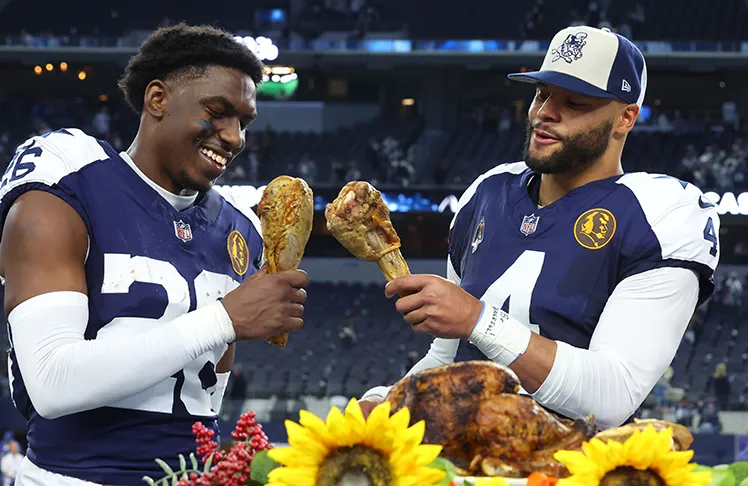
Dallas' DaRon Bland (L) and Dak Prescott enjoy some Thanksgiving turkey after a home win on the holiday in 2023. (Richard Rodriguez/Getty Images via CNN Newsource)
Dallas’ DaRon Bland (L) and Dak Prescott enjoy some Thanksgiving turkey after a home win on the holiday in 2023. (Richard Rodriguez/Getty Images via CNN Newsource)
By Andy Scholes, CNN
(CNN) — Family, food and football: That’s what Thanksgiving is all about.
The NFL has hosted games on the annual November holiday since the 1920s, and the Detroit Lions and Dallas Cowboys are the two traditional teams involved in the afternoon games every year.
It all started back in 1934 – the Lions were a brand-new team struggling to fill their stadium. So, owner George Richards came up with a brilliant idea: Host a game on Thanksgiving Day and broadcast it nationwide on his radio network.
Detroit sold out that first game, and the tradition stuck.
Fast forward to 1966 – Dallas wanted in. The Cowboys were still building their fanbase, and general manager Tex Schramm figured a Thanksgiving game would put “America’s Team” on the map.
He was right. The ratings soared – and outside of a couple years in the 1970s, Dallas has been a Thanksgiving mainstay ever since.
So now every year, Detroit kicks things off early, Dallas takes the late afternoon spot – and since 2006, the NFL has added a primetime game to make it a full day of football feasting from sun-up to lights out.
“It’s a blessing. It’s something that I never take for granted,” said Cowboys quarterback Dak Prescott. “Putting on the special (jerseys), you know, since we went back to the throwback uniforms, it just brings me back to being a kid and watching the Cowboys every Thanksgiving, going outside, playing with my brothers after we ate, or during halftime or whatever it may be.
“And so just to think about all the other families and kids and people out there that are watching us and that we can inspire and just by the way that we play the game, I don’t take it for granted.”
This year’s slate has two great divisional matchups: The Lions hosting the Green Bay Packers in a NFC North showdown, while Lamar Jackson and the Baltimore Ravens host the Cincinnati Bengals in the nightcap with Joe Burrow expected to make his long-awaited return from injury.
In the middle game, Patrick Mahomes will make his Thanksgiving Day debut as he returns home to Texas with the Kansas City Chiefs to take on the Cowboys.
“It’s about rebounding fast, trying to be better, even better this next week going into a big environment, big game,” Mahomes said after defeating the Indianapolis Colts in overtime on Sunday. “It’s going to be a lot of fun going to Dallas and getting to play on Thanksgiving.”
The Thanksgiving Day games have also brought iconic voices into our living rooms for much of our lives and made them synonymous with the day. For many, John Madden and Pat Summerall were the voices of Thanksgiving. They called 20 Thanksgiving games together over the course of two decades and, in 1997, introduced the world to the turducken.
“This is a turducken right here. You know what a turducken is? A turducken is a deboned duck stuffed in a deboned chicken stuffed in a deboned turkey. With stuffing and now you’re talking. And that has eight legs,” Madden memorably said at the time.
Madden began celebrating the players of the game with a turkey leg in 1989 and it is a tradition that is still going today.
Even Tom Brady loves him some turducken, trying it for the first time last year in the Fox broadcast booth: “How did a duck and a chicken get roped into this? They thought turkey was a Thanksgiving thing,” he said, pausing for a bite. “Wow, that’s good.”
From the Lions and Cowboys to the turkey legs and turducken, Thanksgiving football is more than a game – it’s a holiday tradition.
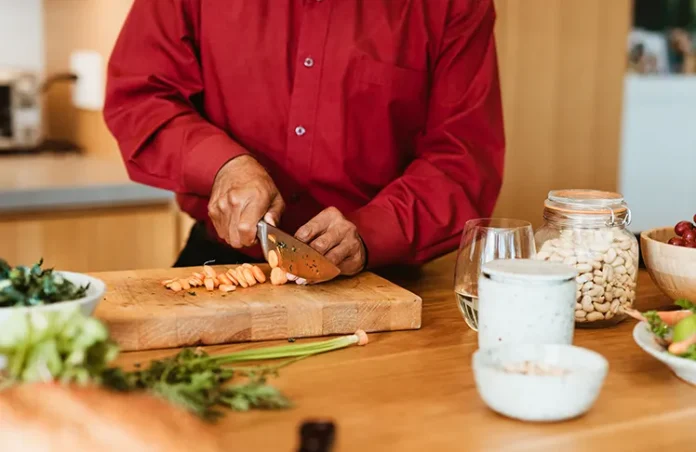
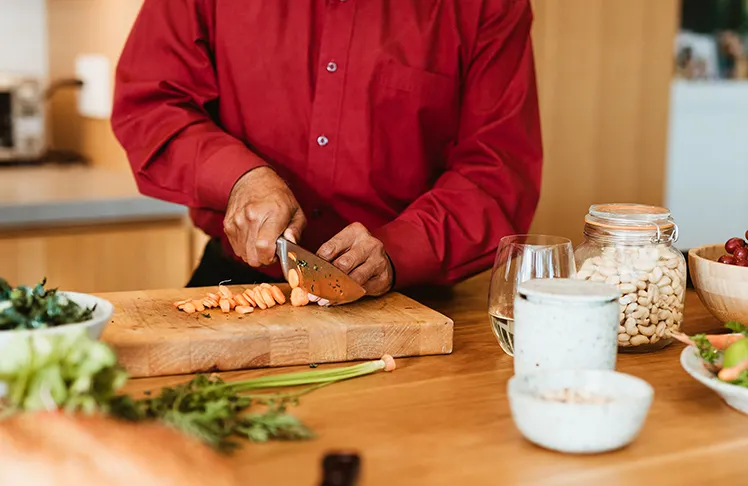
You can help reduce food waste by questioning your meal prep habits and using a whole carrot instead of peeling one. (alvarez/E+/Getty Images via CNN Newsource)
You can help reduce food waste by questioning your meal prep habits and using a whole carrot instead of peeling one. (alvarez/E+/Getty Images via CNN Newsource)
By Francesca Giuliani Hoffman, CNN
(CNN) — Millions of tons of food are wasted each year in the United States alone.
About 35 million tons, to be specific, according to the latest ReFED report. Some 31% of food that is grown and produced goes unsold or uneaten in the US, estimates ReFED, a nonprofit organization focused on reducing food waste.
Half of all the food waste comes from consumers. “That’s either groceries — the strawberries that spoil in your fridge — or the meal you ordered at the restaurant and only hate half of or didn’t eat the leftovers when you brought them home,” said Sara Burnett, executive director of ReFED.
That waste wreaks havoc on our planet, she said, noting that 35 million tons of food waste “is equivalent to the greenhouse gas emission of 154 million metric tons of carbon, which is about the same as driving 36 million passenger cars for a year, and it consumes 9 trillion gallons of water, which is about 13 million Olympic-sized pools.”
On Thanksgiving alone, ReFED estimated that 320 million pounds of food— $550 million worth— will be thrown away in a single day.
The amount of waste is not decreasing even as inflation and food prices rise, according to Burnett, and the cost of being wasteful goes up.
We owe it to our wallets and to the planet to do our darndest to reduce any possible waste. Luckily, there are plenty of ways to preserve fresh ingredients for long-term consumption — by drying, freezing, canning, pickling, baking and repurposing them.
“When I was first learning to cook, if a recipe told me to cut off and discard a kale stem, I did it. I didn’t know it was edible, and I didn’t know about the impacts of wasting food,” said Lindsay-Jean Hard, a writer for gourmet food business group Zingerman’s and author of “Cooking With Scraps: Turn Your Peels, Cores, Rinds, and Stems Into Delicious Meals.”
“Education is a huge piece: questioning our assumptions, educating ourselves, and then sharing that knowledge with others so we can all do a little better,” she noted.
Here are some useful ways to stop wasting food.
Have a food plan
Chef Michele Casadei Massari suggested implementing simple systems at home that work for you such as an “opportunity box” in the fridge, containing “trimmed, labeled bits ready to become soup, salad, or frittata.”
“Buy less but more often, store correctly, pre-portion, and give every item a ‘next-life plan’ the day it arrives,” Massari, CEO and executive chef of Lucciola Italian Restaurant in Manhattan, said via email.
Hard takes those scraps and tucks them into frittatas and stratas.
“Both are great back-pocket recipes, (which means) they’re easy to pull together… and can handle all sorts of odds and ends.”
Her advice for diving deeper into zero-waste cooking is to pick one or two ingredients you are not used to using, maybe stale bread or root vegetable greens, and start incorporating them in your cooking — then add more as you go. (Remember bits of bread can be frozen for other recipes, and vegetables can be pickled or frozen for stock.)
“Many home cooks are already really thoughtful about food utilization, whether from necessity, growing up around it, or being taught. Others of us might not be yet,” she said. But we can get there.
Don’t rinse your jars
Claire Dinhut, a content creator and author of “The Condiment Book: Unlocking Maximum Flavor With Minimal Effort,” is a big proponent of using every last bit of flavor in any jarred or bottled product you have on hand. She demonstrates this strategy in her “never rinse a jar” videos that she posts on social media.
A nearly used up jar of Dijon mustard or mayonnaise is the perfect opportunity to make a salad dressing, she shows in the videos, and an almost empty jam jar can become the perfect vessel for a yogurt bowl, a chia seed pudding and much more.
“My favorite thing that I’ve been doing this summer is — you know, I’ve always loved matcha, but I didn’t realize that I liked different flavored ones,” Dinhut said. “So now, anytime I’m done with a jar of jam or jelly, I always put milk in it the night before, then the next morning, I already have a nice, flavored milk.”
Don’t peel those carrots
It’s important to question any recipe and our ideas around the usable parts of each ingredient. Who says you need to peel potatoes or carrots?
“Having a sense of curiosity and questioning your habits — do you really need to peel that carrot? — is a helpful frame of mind to go into it with,” Hard said.
Scraps can even act as flavor enhancers of their own, as in the case of a banana bread recipe from Zingerman’s Bakehouse, an artisanal bakery in Ann Arbor, Michigan, that uses the whole banana, peel included, Hard said.
“Not only does it reduce food waste, including the peel gives the bread a stronger banana flavor, but it’s a great example of something that truly does taste better made with ‘scraps,’” she added.
You can find the Oh So A-peel-ing Banana Bread recipe in “Celebrate Every Day,” a Zingerman’s cookbook that Hard coauthored. A version of the recipe is also available here.
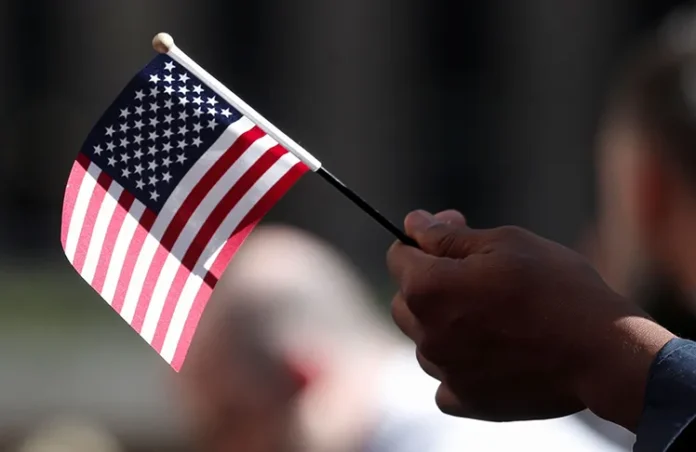
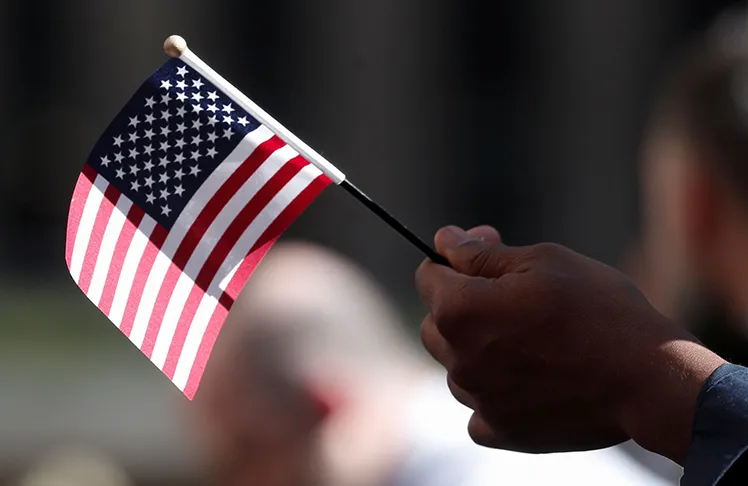
A citizenship candidate holds a flag during the US Citizenship and Immigration Services naturalization ceremony at Rockefeller Plaza in New York, in September 2019. (Shannon Stapleton/Reuters/File via CNN Newsource)
A citizenship candidate holds a flag during the US Citizenship and Immigration Services naturalization ceremony at Rockefeller Plaza in New York, in September 2019. (Shannon Stapleton/Reuters/File via CNN Newsource)
By Kaanita Iyer, CNN
(CNN) — The US will reexamine all green cards issued to people from 19 countries “of concern” at President Donald Trump’s direction, as the Trump administration intensifies its immigration crackdown following the shooting of two National Guard members in Washington, DC.
“At the direction of @POTUS, I have directed a full scale, rigorous reexamination of every Green Card for every alien from every country of concern,” Joe Edlow, the director of US Citizenship and Immigration Services, wrote in a post on X Thursday.
Asked for additional details, including which countries are considered to be “of concern,” USCIS pointed CNN to 19 countries listed in a June presidential proclamation.
The 19 countries include Afghanistan, Burma, Chad, Republic of the Congo, Equatorial Guinea, Eritrea, Haiti, Iran, Libya, Somalia, Sudan, Yemen, Burundi, Cuba, Laos, Sierra Leone, Togo, Turkmenistan and Venezuela.
USCIS said in a statement later Thursday that when vetting immigrants from those 19 countries, the agency will now take into consideration “negative, country specific factors,” which includes whether the country is able “to issue secure identity documents.”
Since officials last night identified the suspect of the shooting as Rahmanullah Lakanwal, an Afghan national, the Trump administration has ramped up its efforts to restrict immigration.
The Department of Homeland Security, which oversees USCIS, said Thursday the administration is also reviewing all asylum cases that were approved under former President Joe Biden.
“Effective immediately, processing of all immigration requests relating to Afghan nationals is stopped indefinitely pending further review of security and vetting protocols,” DHS Assistant Secretary Tricia McLaughlin said in a statement to CNN, adding, “The Trump Administration is also reviewing all asylum cases approved under the Biden Administration.”
Trump said in a social media post Thursday night his administration will work to “permanently pause migration from all Third World Countries to allow the U.S. system to fully recover.”
It’s unclear which countries Trump was referring to. “Third world countries,” used by some to define developing nations, has repeatedly been used by Trump as part of his anti-immigration rhetoric.
CNN has reached out the State Department and the White House for clarity.
Trump wrote in the post that his administration will also, “terminate all of the millions of Biden illegal admissions, including those signed by Sleepy Joe Biden’s Autopen, and remove anyone who is not a net asset to the United States, or is incapable of loving our Country.”
Trump added that he would end all federal benefits and subsidies to “noncitizens” and “denaturalize migrants who undermine domestic tranquility, and deport any Foreign National who is a public charge, security risk, or non-compatible with Western Civilization.”
Lakanwal — who previously worked with the US government, including the CIA — came to the country in 2021 as part of Biden’s “Operation Allies Welcome” after assisting the US in Afghanistan. He applied for asylum in 2024, and the Trump administration granted it in April 2025, CNN previously reported.
The Alliance of Afghan Communities in the United States on Thursday condemned the shooting, while also expressing concerns over the impact of Lakanwal’s actions on the immigration process for other Afghan nationals.
“A single individual’s crime must not jeopardize or obstruct the legal cases of thousands of deserving Afghans who meet all U.S. legal requirements,” the alliance said in a statement, which called for federal agencies to process Afghan immigrants as usual, without delays or suspensions.
More than 190,000 Afghans have resettled in the United States since the US military withdrew from Afghanistan in August 2021, according to the State Department.
In a video address from his Mar-a-Lago club in Florida late Wednesday, Trump blamed the Biden administration for bringing the alleged shooter to the US and argued the attack “underscores the single greatest national security threat facing our nation.”
Trump said in the remarks, “We must now reexamine every single alien who’s entered our country from Afghanistan under Biden and we must take all necessary measures to ensure the removal of any alien from any country who does not belong here or add benefit to our country.”
Trump also lamented what he described as “20 million unknown and unvetted foreigners” who entered the US during his predecessor’s administration, casting it “a risk to our very survival.”
The administration’s latest move to reexamine green cards is in line with Trump’s anti-immigration rhetoric. A green card is a document that deems its holder as a lawful permanent resident of the US. It differs from refugee and asylum programs — which the Trump administration has already sought to limit — though refugees must apply for a green card after one year of being in the US.
This story has been updated with additional details.
Measles deaths have declined sharply since 2000 but cases are now surging, even in countries where measles has been declared eliminated. (Sarah L. Voisin/The Washington Post/Getty Images via CNN Newsource)
Measles deaths have declined sharply since 2000 but cases are now surging, even in countries where measles has been declared eliminated. (Sarah L. Voisin/The Washington Post/Getty Images via CNN Newsource)
By Asuka Koda, CNN
(CNN) — For decades, measles vaccination has been a global success story. Deaths from measles dropped 88% around the world from 2000 to 2024, according to a new report from the World Health Organization, with an estimated 58 million lives saved in that time.
But now, with vaccine coverage well below the level needed to stop transmission, cases are surging. Fifty-nine countries reported large or disruptive measles outbreaks last year, almost triple the number reported in 2021. A quarter of outbreaks are happening in countries previously declared measles-free, including Canada and the United States.
“Global measles elimination remains a distant goal,” according to the WHO report released Friday. The progress of the last decades is in peril with the return of outbreaks and decline in resources for immunization and disease surveillance, according to the report — in particular, the US government’s reduced support for global health.
Elimination means a virus is no longer circulating and that a country has the capacity to “shut down” infections that come in via visitors and travelers. Canada recently lost its elimination status, and WHO is also concerned about the US backsliding and losing its status, said Dr. Kate O’Brien, director of the WHO’s Department of Immunization.
The US Centers for Disease Control and Prevention reports that there have been 1,798 confirmed measles cases in the US this year, the highest number of cases since the country reached elimination status in 2000.
“Measles remains the world’s most contagious virus,” WHO Director-General Dr. Tedros Adhanom Ghebreyesus said. Even though there’s a highly effective low-cost vaccine, the disease “exploits gaps in immunization coverage.”
Globally, more than 30 million children were under-protected against measles in 2024.
Victories and challenges
There have been some victories, officials say. Measles deaths have dropped sharply since 2000. Every WHO country and region has committed to eliminating measles and rubella by maintaining at least 95% vaccine coverage, strengthening surveillance systems and making measles elimination goals part of broader health care efforts.
Recently, Cabo Verde, Seychelles and Mauritius became the first countries in the African region to achieve measles elimination this year. Twenty-one Pacific island countries also eliminated measles and rubella this year.
“We have made measurable progress towards measles elimination,” said Diana Chang Blanc, unit head of WHO’s Essential Program on Immunization. But progress toward elimination is “still too slow. Cases and deaths are still unacceptably high.” Every measles death is preventable with a low-cost vaccine.
Three countries have yet to give the second dose of a measles vaccine as standard practice. That’s important, Chang Blanc said, because the second dose “increases vaccine effectiveness to 95%, providing most individuals with long-lasting immunity.”
In 2024, only 84% of children received the first dose and 76% received the second dose globally. “This means that 30 million children remain underprotected from measles in 2024,” Chang Blanc said. “Children living in fragile, vulnerable conflict-afflicted settings are the most adversely affected.”
Progress is not happening at the expected pace, she said, because of lower global immunization rates and backsliding of vaccination since the Covid-19 pandemic. It has been challenging for children who missed recommended vaccines during the pandemic to catch up.
Measles acts as a “fire alarm for immunization programs,” O’Brien said. When the disease resurfaces, “it warns that there are gaps in immunization coverage” and health care access inequities. That same gap persist with other vaccine-preventable diseases, too, like whooping cough and polio.
Slowing progress to elimination
The alarm has already been sounding on vaccines. The Covid-19 pandemic disrupted immunization program around the world. Measles vaccination levels are still slightly below pre-pandemic levels.
Misinformation and disinformation are notable factors in slowed vaccination rates, WHO says. But access is still the most significant problem.
Chang Blanc said that the breakdown or lack of “a strong foundation in the routine immunization system” is the No. 1 reason for high measles case counts and outbreaks.
Although it sounds simple, Chang Blanc said, those routine systems require trained health workforces, logistic systems, transport, surveillance systems and other resources that many countries do not have.
The major barrier to reaching 95% measles vaccine coverage is “access to populations that need it most,” Chang Blanc said.
Deep funding cuts affecting the Global Measles and Rubella Laboratory Network, which include 760 laboratories that help surveil and respond to outbreaks, and country immunization programs are “feared to widen immunity gaps and drive further outbreaks in the coming year,” the report says.
“Securing sustainable domestic financing and new partners is now a critical challenge to advancing efforts toward a world free of measles,” the report says.
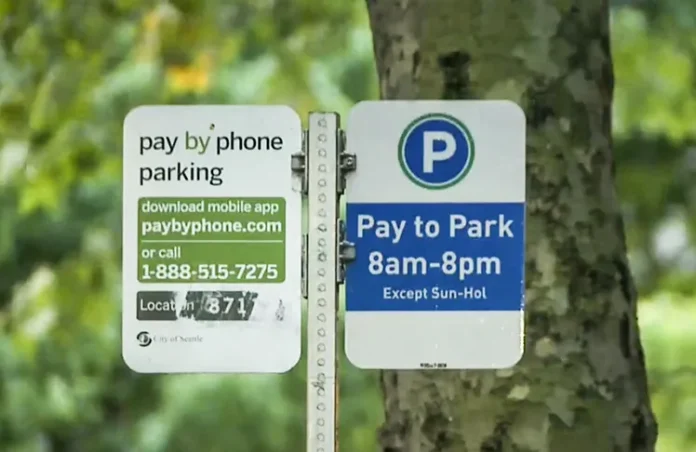
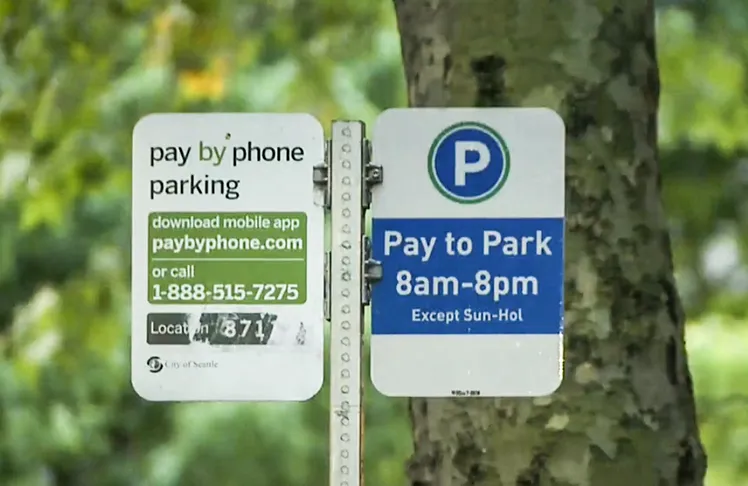
Seattle’s most notorious locations for parking tickets are not found in the bustling areas of downtown or Capitol Hill. Instead, the leading spot is in Ballard, specifically at 8498 Seaview Place N.W., the parking lot at Golden Gardens Park. Between January 2024 and September 2025, a staggering 3,920 citations were issued here—over four times the number at the second-highest location. Interestingly, the primary cause of these tickets wasn’t expired meters (as parking at Golden Gardens is free) or the common issue of cars parked on the grass due to summer crowds.
According to a Secret Seattle article, the majority of citations were for expired tags or improper plates. Parking in Seattle can be a challenging experience, with nearly 650,000 parking citations issued citywide during the same timeframe, based on data from the Seattle Municipal Court. Gene Balk, known as the FYI Guy for The Seattle Times, analyzed this data and found significant discrepancies in ticket issuance across various addresses.
Following Golden Gardens, the second most ticketed area is in South Lake Union, located at 1050 Valley Street, near Lake Union Park. The University District claims the third spot, specifically the 1000 block of Boat Street. Additional locations rounding out the top five include the city parking lots at Magnuson Park and Seward Park.
Most parking fines in Seattle range from $43 to $78, but serious violations can result in fines as high as $250. If you’re looking to avoid parking tickets, be aware that the busiest days for ticketing are Tuesday through Friday, with Wednesday being the peak day, while Sundays see the fewest citations. The most frequent violation involves failing to pay at metered spots.
The key takeaway? Always pay for metered parking—especially on weekdays! And if you’re heading to Golden Gardens, consider alternative transportation options like a bus or bike, especially if your tags are expired.
(Trice Edney Wire) – It’s the end of the year, which means you are being barraged by requests to give. Whether it is your alma mater, your church, a charity you gave to once upon a time, even a long, long time ago, you are getting repeated requests to give. Giving Tuesday, this December is December 2, and the encouragement to give is not a bad thing.
The Giving Tuesday concept began in 2012, when the United Nations Foundation and New York’s 92nd Street Y, a Jewish cultural and community center in New York, saw it as relief from the rampant consumerism that defines this so-called holy season. The frenzy begins on or before “Black Friday”, where in the past fools lined up to score bargains on electronics, sometimes so frantically that they rushed into big box stores, stampeding guards and fellow consumers. It continues to “Cyber Monday, where people are encouraged to buy online. Giving Tuesday is an attempt to center on giving, not spending. It has even spun into a nonprofit organization that encourages giving.
Let’s put this in context, though. Black people are givers. Proportionately we give more than most. We give because that’s how we got over. From mutual aid societies during and after the enslavement period through the fried chickens and pound cakes that sustained our Historically Black Colleges and Universities “back in the day” (and even now), giving is a core value for African American people. We don’t necessarily need the nudge to give on “Giving Tuesday”. Black folks always give, even when we have less than the majority community does. Instead, this day serves as a reminder that most philanthropy reflects the structural inequity that defines our predatory capitalistic society. And the Giving Tuesday focus on collective philanthropy, which includes giving money, time, advocacy or support to those in need. Right now, with the global, national and local challenges we fact, the Spirit of Giving Tuesday is important now, more than ever.
Let’s not overlook the inherent inequality in the philanthropic space. Charity can relieve symptoms, but it cannot repair structural inequality. The roots of the racial wealth gap—land theft, labor exploitation, exclusion from credit, and racially targeted policy—go far deeper than any one day of goodwill can touch.
Still, Giving Tuesday offers an important window. It calls us to remember that philanthropy is not the exclusive province of billionaires. Black communities have always given out of necessity, solidarity, and survival. We gave when the Freedmen’s Bureau failed us. We gave when federal farm policy dispossessed Black farmers. We gave through churches, benevolent societies, burial clubs, freedom schools, mutual aid, and community defense. Our giving was not episodic; it was infrastructural. It kept our communities alive when state violence sought to extinguish them.
Giving Tuesday becomes not just a day of donations but a chance to interrogate where our dollars go, why our communities still need so much, and how we can align generosity with justice. Instead of reacting only to crises, we can think strategically—supporting organizations fighting voter suppression, advocating for reparations, training Black economists, building cooperative enterprises, and holding policymakers accountable for the inequities they continue to produce.
Charity alone cannot undo the legacy of lynching culture, economic envy, and policy violence—central forces in the theft of Black land and Black futures. But a day that encourages Americans to pause the spending frenzy and consider generosity is not without value. We can reclaim Giving Tuesday as not just an appeal from nonprofits but an invitation to reflect: How do we build the world we deserve? What might generosity look like when it centers systemic repair, not performative benevolence?
Giving Tuesday began as a social-media campaign. It has become, at its best, a moment of collective pause. Use it—whether by giving, advocating, or simply asking harder questions about how our nation allocates abundance. Generosity guided by justice is not just charity. It is strategy. So if you are African American and you participate in Giving Tuesday, Give Black. If you are an ally and concerned with social and economic justice, Give Black. If you care about historical inequities, Give Black. Really, you never need an excuse of a reason to Give Black.
Dr. Julianne Malveaux is an economist and author. http://www.juliannemalveaux.com/. Click or tap to follow the link.” data-auth=”NotApplicable” data-linkindex=”0″>www.juliannemalveaux.com. To receive her column and other thought from her weekly newsletter, please subscribe at malveauxnewsletter@gmail.com
Pre-saving money on payday instead of spending is a fantastic way to reach your savings goals and build an emergency fund.
Some people might call it “paying yourself first.” This means allocating money each pay cycle to a savings account to achieve future financial goals — not taking funds to splurge or spend.
Whether you’re saving to retire early, travel, buy a car, buy a house, or start a college fund, saving money first with each paycheck can help you reach your financial goals.
Follow these pre-saving tips to get started.
How to Set Savings Goals
As you start saving, build an emergency fund first that covers three to six months of living expenses or unexpected expenses, like replacing a major household appliance, making car repairs, or carrying you through a layoff while you look for a new job.
With a solid emergency fund in place, setting savings goals can help you achieve your future financial goals. To help ensure the most success, set very specific goals instead of having a “rough idea” of how much you want to save.
Instead of thinking, “I want to save more,” set a specific dollar amount and a deadline to meet that goal. For example, write your goals in a notebook or planner and say, “I want to save $5,000 for a down payment on a car.”
Next, set a realistic deadline for achieving your savings target. In the car example, if you want to save $5,000 in one year, you need to save $417 each month. If that seems impossible, you might want to extend your timeline or find ways to increase your income or cut expenses to achieve it.
Open Multiple Accounts for Each Savings Goal
It’s a great idea to open multiple savings accounts for different savings goals. Many financial institutions allow customers to put money in multiple savings buckets for each goal, like a car fund, vacation fund, or house fund, to name a few. This also keeps your finances organized.
Photo: andreypopov via 123RF
How to Pre-Save Money Every Payday
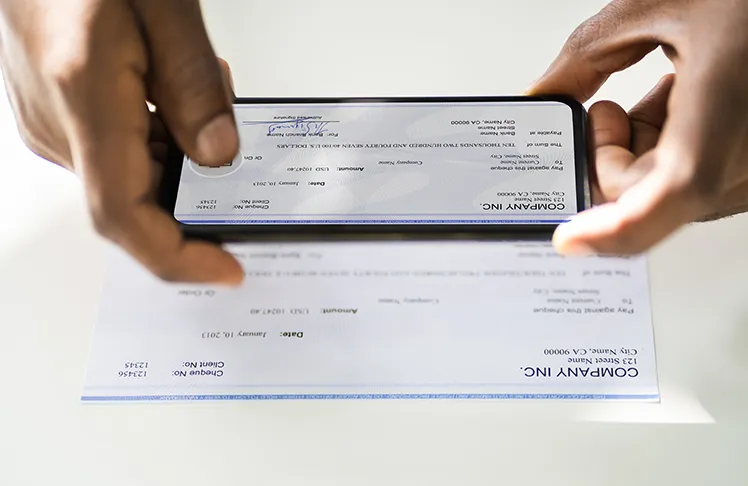
The easiest way to pre-save money every payday is to set up an automatic transfer from your checking account to your savings account via your direct deposit paycheck from your employer.
You can also ask your employer’s payroll department if they can split your paycheck and direct deposit designated dollar amounts into multiple bank or investment accounts.
Either way, electronic savings transfers are seamless and help you avoid spending impulses and learn to live with less money in your net pay.
Use Visual Savings Trackers to Monitor Your Progress
Setting and sticking to savings goals is a huge commitment. If you truly lock into the process, reaching your savings targets is a terrific reward.
Using visual savings trackers enables you to monitor your progress. There are various tools to help you visually confirm whether your savings targets are on track.
Here are some examples:
Use an electronic spreadsheet, like Excel or Google Sheets. You can set up columns for the date and amount you save and create a formula to calculate a running total.
Manually write your savings amounts in a bullet journal. Some people prefer putting pen to paper to record their progress visually. You can use a bullet journal to list your savings goals, deadlines, actual savings amounts, and create a to-do list.
Start an envelope system by putting specific amounts of cash into envelopes you dedicate to each savings goal. Bear in mind that saving cash this way eliminates an opportunity to earn interest on your savings in a bank, money market, or investment account.
Create a visual savings chart, such as a bar graph or pie chart, and color in the sections/bars as your savings accumulate.
Leverage your bank’s online spending and savings tools. Many financial institutions create graphs and diagrams that categorize your expenses and track your savings goals.
Cut Expenses to Hit Savings Goals
If your finances are tight or you need to hit your savings goals quickly, you may need to cut expenses or boost your income with a side hustle.
Reviewing bank statements and using budgeting apps can help identify overspending and list where your money is going.
Consider cutting digital streaming or magazine subscriptions, limiting takeout meal expenses, and tightening your entertainment budget. Eliminating frivolous, unnecessary, or impulse spending can free up more cash to put into savings.
When it comes to saving money first each payday, following these tips will help you set and achieve your savings goals.
The Trump administration’s recent use of food stamp benefits as a political football— and the president’s willingness to withhold funding — demonstrated how quickly lower-income Americans can end up on the brink of not having enough for their families to eat.
It’s hard to place that vulnerability in a sensible context. The U.S. is the world’s third-largest producer and leading exporter of food, and America wastes between 30% and 40% of its food supply every year, according to the U.S. Department of Agriculture. Yet more than 47 million people in this country, including millions of children, either don’t have enough to eat or don’t know where their next meal is coming from.
All of which brings us to a day in 2017 when a resident of the city of Inglewood approached workers at the Social Justice Learning Institute with a question. The man explained that he’d noticed local school students couldn’t get the same access to healthy food on weekends that they received through the school meal program during the week.
Did the people running the program, the man wondered, have any ideas on how to keep healthy food coming into the community on days when there was no school?
Workers with the Inglewood-based institute, which was founded to improve the well-being of communities of color — the city is more than 90% Black or Latino — stewarded a number of community gardens in the area. But they knew they were going to need far more resources to make healthy food available on a regular basis to the students — and families — in question.
“And then we thought, ‘Oh, actually, we know someone with lots of food. Let’s call them,’” said Nicole Steele, the health equity programs director for the institute. So began a partnership with Food Forward that, eight years later, continues to bear fruit.
Food Forward, a nonprofit recovery and distribution program born in the nearby San Fernando Valley, has become a powerhouse when it comes to saving fresh produce from wholesalers, vendors, and neighbors that otherwise would be thrown out, then redirecting it to those in need.
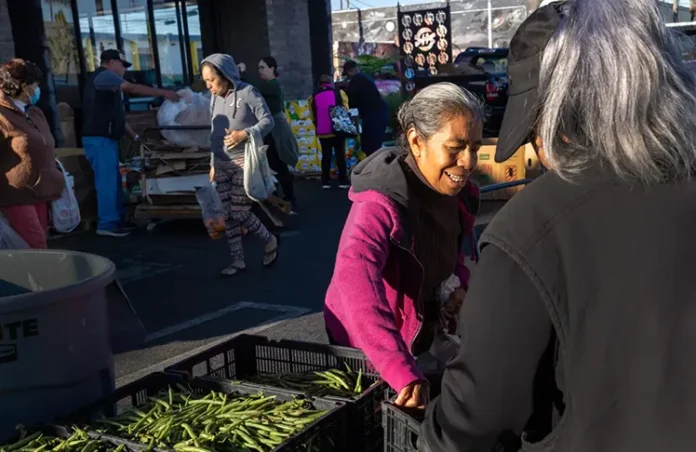
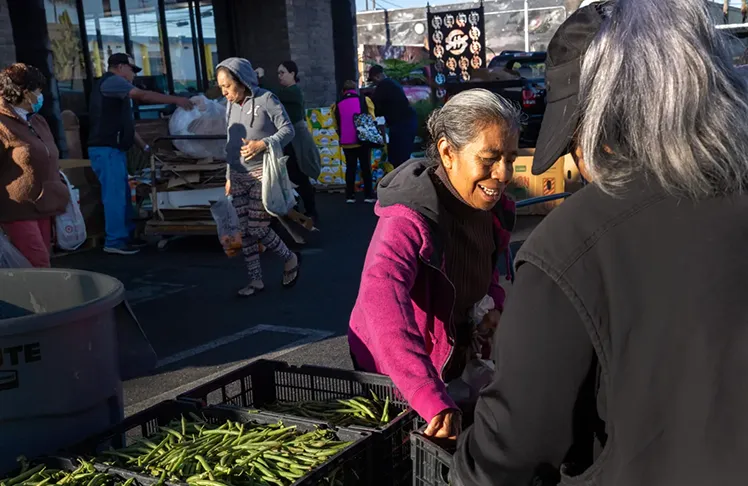
Donated produce is distributed at the WLCAC-FamilySource Center in Watts.
That premise is simple; its mechanics, not so much. But the bottom line is that Food Forward has recovered and distributed more than 545 million pounds of fresh fruits and vegetables in 16 years — and its area of service, once a small perimeter of local food pantries, now comprises community programs throughout California and in six other states.
“Last year, we moved enough produce to fill the USDA nutritional needs of more than 300,000 people — a day,” said Rick Nahmias, the founder and CEO of Food Forward. “That is a massive amount of produce.”
The fruits and vegetables reach people who likely wouldn’t receive fresh produce otherwise. Their redirection also prevents the produce from decomposing in landfills and releasing greenhouse gases like methane into the atmosphere.
And Food Forward can quickly ramp up operations. In response to the Trump administration’s freezing of SNAP benefits in November, the organization announced that it was nearly doubling the number of YMCA partner distribution sites it worked with, which added 2.4 million servings of fruits and vegetables for needy families in Los Angeles County.
“Food Forward is picking up where SNAP left off, helping to ensure that nutrition is a priority in the food made available during this crisis,” Nahmias said in a statement.
The distribution system is a provably scalable model, especially in a produce-rich area like Los Angeles. It works. And perhaps its least-noticed feature is one that, lately, seems to matter more and more: It receives no federal funding, meaning Donald Trump’s government isn’t much concerned with it.
* * *
The origins of Food Forward trace to a slow dog and some long walks. In 2009, Rick Nahmias was thinking about what came next, after years working as a photographer for nonprofits and volunteering for political causes, including Barack Obama’s first presidential campaign. He also had Scout, a 13-year-old “lab-adjacent” rescue pooch, whose daily neighborhood strolls were becoming more leisurely.
A resident of the fruit-rich San Fernando Valley, Nahmias began to notice on their walks how many of his neighbors’ yards were filled with citrus trees — and how many of those trees were pouring forth more fruit than the owners could possibly consume.
At the same time, he’d been watching news reports about growing lines at food banks, as the Great Recession worsened.
“I started seeing this equation around food waste,” Nahmias said. “I thought, ‘What if we got some volunteers together and harvested some of this fresh produce?’ It seemed like a real two-plus-two-equals-four situation.”
Actually, it added up to 800 — pounds of citrus that Nahmias and a small crew of volunteers harvested from neighbors’ trees over three weekends. They delivered the fruit to workers at a nearby food bank, SOVA.
“To my surprise, they were thrilled with it,” Nahmias said. “And the idea just took fire. It was really crazy and humbling how many volunteers came out, how many homeowners offered their yards to us and how many pantries started knocking on our door.”
A dog perches atop a box of donated produce at the WLCAC-FamilySource Center.
In its first year, Food Forward volunteers hand-picked 100,000 pounds of citrus, mostly from the backyards of area homes and a few private orchards. That total seems quaint in 2025, when the organization routinely moves close to half a million pounds per dayof different kinds of fresh produce.
In the process, the program collaborates with more than 250 groups that Nahmias describes as “hunger relief partners”: food banks, youth homes, after-school programs, domestic violence shelters and many others.
Put simply, the organization scaled up. Backyard and small orchard harvesting now accounts for only about 5% of the operation. Almost all of the rescued produce comes from the Los Angeles area’s massive wholesale industry, which connects growers and importers to retail food businesses, moving fruits and vegetables to points throughout the western United States.
* * *
So what’s with all the surplus food? The answer lies in the vagaries of the industry. Official estimates say more than a third of the food produced in the U.S. every year goes unsold or uneaten and is generally thrown out, a reality bafflingly at odds with the high number of food-insecure Americans.
California is the leading grower of fruits and vegetables in the nation, but, according to data from the U.S. Census Bureau’s Household Pulse Survey, more than one in five California homes were “food insecure” in 2024, meaning they had limited or uncertain access to adequate food. For households with children, that figure rose to more than one in four.
Redirecting unused food is one way to combat that. Often, vendors and supermarkets throw out produce because it has minor blemishes or incorrect color that would make it difficult to sell, or simply because the supply of certain seasonal fruits and vegetables outstrips market demand. If it’s not moved quickly enough, that food is in danger of spoiling.
In L.A.’s booming wholesale business, which operates primarily from the Los Angeles Wholesale Produce Market downtown, that dynamic is always in play. The market handles not only California-grown produce but much of the massive quantities of fruits and vegetables that are imported through the Port of Los Angeles.
Food Forward Chief Operating Officer Kristen Johnson said that what makes L.A. unique is both the amount of fresh produce available and the variety of service organizations that can accept and redistribute the food. “That’s the linchpin for moving the food around as quickly as you have to with produce,” Johnson said.
Generally, “quickly” means a 48-hour turnaround within the greater Los Angeles area, which remains Food Forward’s first priority for service.
About five years ago, the organization opened a 30,000-square-foot warehouse in the city of Bell, near the L.A. warehouses of many wholesalers, making it easier to rescue and divert the wholesalers’ daily surplus to where the need is.
Nahmias said the massive refrigerated facility allows for food to be stored for a few days, if necessary, and for more than 200 types of plant-based produce, all of it fresh, to pass through the warehouse over the course of a year.
Donated produce is boxed and distributed to community members at the WLCAC-FamilySource Center.
* * *
Food Forward is no longer a backyard venture. Johnson said the program has a cash operating budget of $9.2 million this year and a full-time staff of more than 50. Funding comes from individual donors, corporate sponsors and philanthropic foundations.
There is room for far more growth. “We could probably grow exponentially if our fundraising could keep pace,” Johnson said.
Still, the organization has received very little government money even though that is often a funding source for nonprofits looking to grow. It’s a mixed blessing.
Historically, government money has helped programs like Food Forward scale up. But the Trump administration’s defunding of many such programs means that expanding further via federal grants currently seems out of reach.
“We were poised to begin getting some federal funding last year, because they were starting to see [combating] food waste as a major opportunity to fight hunger,” Nahmias said. “That has completely been sidelined. But because we were never yoked to federal dollars, with our model and the nimbleness that we’re known for, we will continue to expand.”
That also means that Food Forward is unlikely to be harmed by a sudden withdrawal of government support. It’s not perfect — Nahmias, Johnson and Food Forward’s three-person finance team have to continue shaking private money trees to grow — but the organization’s leaders say the operation remains light on its feet.
While the amount of produce moving through the Los Angeles market is greater than it would be elsewhere, Nahmias believes that the model he used to first build Food Forward — giving excess food to people who need it before it rots — can work anywhere. “Every region has produce of some kind,” he said. (New York and San Francisco both have had food recovery programs for decades, and recently they’ve begun to ramp up their scale.)
Meanwhile, Food Forward continues projects like the one it began in conjunction with the Social Justice Learning Institute in Inglewood. Not long after the institute contacted it, Food Forward began delivering one massive truckload of fresh produce to a local school site every Friday, before the food was redistributed to individual families, churches, local food banks, clinics and other places where hungry people congregate.
The institute now has its own truck that it uses to load produce at the Bell warehouse and, when needed, drive it to its destinations.
“The Friday food hub itself is between 15,000 and 18,000 pounds of produce, which serves around 5,000 people, and then we do another 15,000 to 30,000 during the week,” said Steele.
“That’s all from Food Forward. They’re filling a gap — and how else would we do this?”
This post first appeared at Capital & Main.All photos by Barbara Davidson.
The list of headwinds Black grade-school students must have to overcome to earn a high school diploma seems never-ending. And that’s without talking about President Donald Trump’s plan to dismantle the Department of Education.
Yet there are some bright spots for Black public schoolchildren, even in a system that seems disinterested in their success, if not dedicated to their miseducation. So I’d like to give a toast to the five things that Black students can be grateful for in 2025.
Black Male Teachers Are Helping Black Children Improve in Schools
In a profession that’s overwhelmingly female and largely white, Black men make up around 1% of the teaching workforce. But research shows they can have an outsized impact on the development of young Black boys — reducing discipline and dropout rates while increasing achievement and graduation rates.
Researchers say that’s because Black men who teach bring a greater sense of cultural understanding to the classroom, and are more interested in forging connections with Black students — a crucial skill in their success. And several organizations are working to increase the number of Black men in the teaching ranks.
“Reading Rainbow” Made a Comeback…With a New Host, Too
The show, which first aired in 1983, was hailed for encouraging a generation of young readers. Originally hosted by actor LeVar Burton, Reading Rainbow was famous for its “magazine-style” format, with the genial Burton introducing topics. Celebrity guest readers would also join the program, and children would have the opportunity to discuss their favorite books.
Parents and fans despaired when the show went off the air in 2009. But PBS, which aired the program, returned Reading Rainbow to the air Oct. 4, with Mychal Threets, a former librarian at the Solano County Library in California and TikTok star, as the new host.
Children can see Mychal on YouTube, where he’ll be reading some amazing children’s books along with some guests, too. Threets’ revival builds on this tradition with a modern twist.
More Black Students Are Graduating on Time
After years of languishing well behind white and Asian American students, the percentage of Black students who are graduating high school within four years of enrolling is on the rise. National data shows the on-time graduation rate for Black students in the 2022-2023 school year was about 81%, which is far higher than it was about a decade ago.
Even though the national average — around 87% — is higher, the progress Black students have made in earning their diplomas on time, given all the challenges they face in the public school system, is amazing.
SNAP Benefits Are Back
Experts agree: it’s hard for children to learn when they come to school hungry. That’s why the lapse in funding for the Supplemental Nutrition Assistance Program, which provides monthly cash assistance for families in need, during the government shutdown became an education issue. Some schools even set up food pantries to help feed families in need.
In 2023, 14% of Black households with children and 14% of Hispanic families with children experienced food insecurity — a share far higher than the roughly 6% rate for white households, Word In Black previously reported. With the return of SNAP benefits, Black children no longer have to worry about where their next meal is coming from when they return to school.
Black Students Are Still Applying to College
In 2023, when the Supreme Court declared that race can’t be considered in college admissions, it sent a shockwave through the higher education landscape. Experts predicted a generation of Black students would be turned away from campus, or wouldn’t even bother to apply.
Two years later, however, the share of Black students applying to college has grown by 12% since the 2023-2024 academic year, according to a report from The Common App. And Black Americans’ share of the pool of college applicants slightly increased from 14% in the 2023-2024 to about 15% in 2024-2025.