By Kiara Doyal, The Seattle Medium
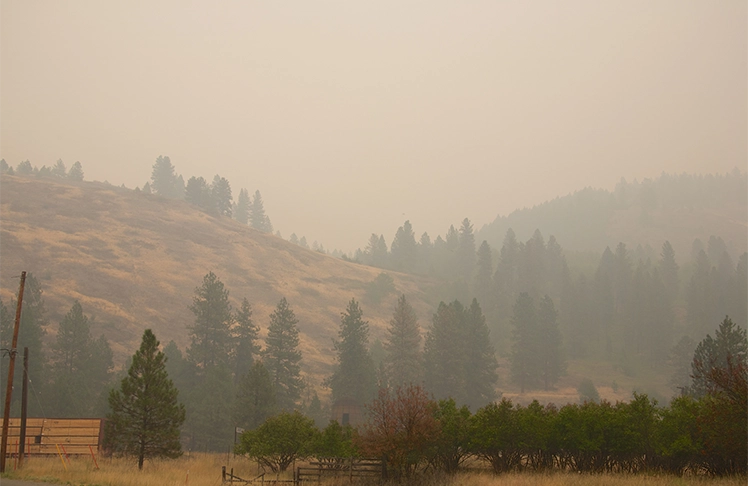
As wildfire smoke continues to affect Washington, public health experts are warning that exposure to smoke, particularly during periods of poor air quality, can affect more than the lungs, with research linking it to respiratory and cardiovascular problems and emerging concerns about mental health. Children, older adults, people with chronic health conditions and outdoor workers are among those who can face heightened risks.
Those risks can be compounded in communities already exposed to higher levels of air pollution, including parts of South Seattle where residents live near highways, industrial activity and the airport, according to University of Washington public health experts.
Anjum Hajat, an associate professor of epidemiology at the UW School of Public Health, said children, older adults and people with pre-existing chronic conditions are particularly vulnerable to the effects of wildfire smoke.
“Both ends of the life course tend to be a little more affected. That’s because kids’ lungs and stuff are still developing, so it’s a little bit harder for them to process all the smoke. And then the other group that is particularly influenced is people with already pre-existing chronic conditions,” said Hajat. “It sort of makes it worse than to have an additional environmental hazard when you’re already dealing with something like heart disease.”
Joan Casey, an associate professor of public health at the University of Washington School of Public Health, said short-term exposure to wildfire smoke has been associated with increased emergency department visits, particularly among people experiencing respiratory problems.
“Things like asthma exacerbations or exacerbations of COPD (chronic obstructive pulmonary disease) are probably the most common thing that researchers have seen. There’s also been some indication that cardiovascular disease exacerbation can pick up following short-term smoke exposure,” said Casey. “I’d say there’s now kind of some new evidence looking at mental health outcomes. And so, we’ve also seen in the acute healthcare setting increases in care seeking for mental health following short-term exposure.”
One of the primary health concerns associated with wildfire smoke is fine particulate matter, often referred to as PM2.5. These microscopic particles can travel deep into the lungs and enter the bloodstream.
“Those little particles that are less than 2.5 micrometers in diameter can get deep into the lungs and get into the bloodstream, and that can lead to things like inflammation, oxidative stress, potentially DNA damage or epigenetic changes, and that’s what we’re concerned about,” said Casey. “Inflammation is connected to a whole host of health problems, and so that’s one major mechanism we’re thinking about.”
The health risks associated with wildfire smoke can also be compounded by existing environmental inequalities. Hajat said lower-income communities and communities of color may already experience poorer air quality because of factors such as fewer trees and less green space and greater proximity to highways, industrial areas and airports.
“We often do worry a little bit more about low-income communities and minoritized communities because they tend to have worse air quality than wealthier or whiter communities. Like the way the trees are distributed. Trees provide a buffer against air pollution, and a lot of poorer communities don’t have as much green space or greenery,” said Hajat. “In South Seattle, where lower-income communities live, tend to be more point source pollution, and the airport is there, right? So on top of the wildfires, you’re also having the highways and the industry and the airport. So it’s like everything is compounded in certain communities.”
The effects of wildfire smoke are not limited to physical health. Casey said living through periods of heavy smoke can also affect people’s mental well-being as outdoor activities are canceled and residents spend more time inside.
“From a mental health perspective, the kind of anxiety and dread that comes from living in a place that’s really affected by smoke impacts our mental health,” said Casey. “Having to cancel daily activities, and being kind of trapped indoors, those sorts of things can also, I think, impact our mental health.”
For outdoor workers, avoiding smoke can be particularly difficult because staying indoors may not be an option. Hajat said many outdoor workers also come from communities already facing environmental and economic disparities.
“It’s quite possible that many groups are still out there working in not great air quality conditions, which is detrimental to their health, and of course, who are these people,” said Hajat. “They again tend to be sort of lower-income and minoritized individuals that work in these very outdoor preferred jobs.”
Casey said people working outdoors face greater exposure, particularly when physically demanding work increases their breathing rate. She said workers should ideally wear a KN95 or N95 mask when air quality is poor, while employers can help by reducing activity levels or providing additional breaks.
“People that work outdoors are certainly the most exposed, and when your livelihood depends on having to be outside, there’s simply more exposure. Filtering out air can be more challenging, especially when the work itself might increase your respiratory rate,” said Casey. “Folks who are working outdoors ideally would be wearing a KN95 or an N95 mask when the air quality is poor, and lowering their activity levels can help protect their health when smoking outside.”
For residents trying to determine when conditions have become unhealthy, Casey recommends monitoring the Air Quality Index, or AQI, rather than relying solely on whether smoke is visible or can be smelled.
“I think a lot of people still rely on smelling smoky outside or looking smoky outside to trigger behavior change,” said Casey. “I’d encourage people to look at the air quality index or the AQI to get a more accurate picture of how safe the air is outdoors because once you can smell smoke, things are already pretty bad.”
When conditions deteriorate, staying indoors and improving indoor air quality can help reduce exposure. Hajat said protecting indoor air does not necessarily require purchasing expensive air purifiers.
“You can create some very low-cost air filters by using a box fan, and then just taping on a filter on the back. You don’t need to go out and buy a $300 air purifier for your house, and you know you need them in every room, so it gets very pricey, right,” said Hajat. “I just want to make sure that people understand that there are ways to protect themselves, and that they should be sort of taking advantage of that.”
As smoke events become more frequent, Hajat said preparing for poor air quality may increasingly become part of protecting public health in Washington rather than something residents consider only during an occasional wildfire.
“I think with climate change, we are seeing just increasing wildfire smoke every year, and the seasons are getting longer and longer. We do get a little break in the winter, but it’s very possible that in the future we’ll have times where we are seeing smoke at all sorts of times,” said Hajat. “And it could be not just seasonal. So it is a function of climate change, which is the real sort of root cause issue that we need to tackle.”