By Kiara Doyal, The Seattle Medium
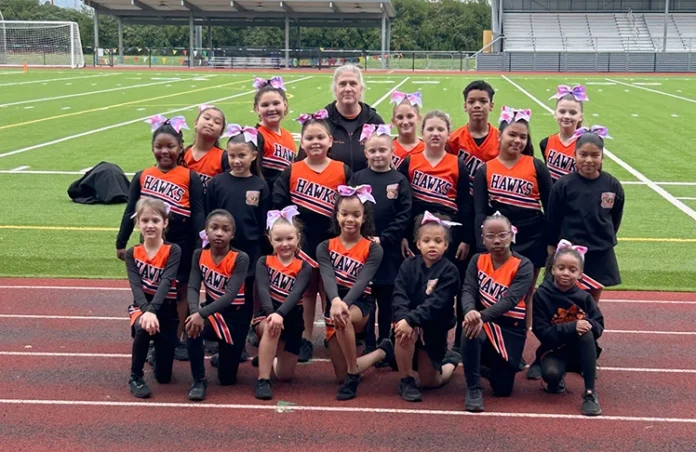
For more than two decades, Kari Schild has helped young athletes find a place within the Federal Way Hawks cheer program, including children with physical or developmental disabilities and behavioral challenges who may have struggled to find opportunities elsewhere.
What began 23 years ago when Schild volunteered because her 8-year-old daughter wanted to cheer has grown into a long-term commitment to creating a program where young people can participate, make friends and experience being part of a team.
“I’ve been here for like 23 years,” said Schild. “My youngest daughter at the time, who was eight years old, wanted to cheer, and they were short on coaches, so I got involved.”
Schild initially became a head coach before eventually moving into the cheer director role. Her daughter aged out of the program years ago, but Schild stayed.
“I have been in the cheer director role for at least 15 years,” said Schild. “My daughter aged out at 14, and she is going to be 30 this year.”
What has kept Schild involved, she said, goes beyond cheerleading itself. She takes particular pride in making the program accessible to athletes with different needs and abilities.
“On the cheer side, we are willing to accept any athlete, regardless of physical or mental disability, behavioral challenges, and that brings me the most joy,” said Schild. “And I want to say that we’re one of the few programs that will accept anybody, and not judge or be like it’s just not going to be a good fit.”
That philosophy has allowed Schild and her coaches to give young athletes opportunities they might not otherwise have.
“I just appreciate being able to give those athletes an experience of a group activity and showing what they can do,” said Schild. “Even if they are struggling behaviorally at home or in a classroom, they can still succeed in the realm of cheerleading.”
One experience that has stayed with Schild involved an athlete with cerebral palsy who wore leg braces. Schild said the athlete and her parents had struggled to find a program that would allow her to participate fully before coming to the Hawks.
“We were the only program that she and her parents could find that would let her participate in every aspect on the sideline, even on the competition floor,” said Schild. “Then, she actually was able to do a photo shoot for some medical magazine wearing her uniform.”
Creating those opportunities is only one part of Schild’s role. Her work begins shortly after the Fourth of July, when practices get underway several days a week. In addition to teaching athletes, Schild communicates with parents about expectations and the commitment required from participants while coordinating uniforms, accessories and other details for the program.
By August, the Hawks can have three or four games scheduled in a weekend. Schild works to make sure cheerleaders are represented at games while continuing to manage practices and the needs of the program.
“Lots of communication, ordering the accessories, making the hair bows, all of that fun stuff, and then we start games in August,” said Schild. “In my role, I separate my squad to cheer and make sure to do my best to attempt to have cheerleaders at every game, and then just continue that throughout the season.”
Around the middle of September, athletes interested in expanding their cheer experience can begin preparing for recreational competitions.
“Practices go down, and we branch off and do recreational cheer competitions,” said Schild. “We start having practices for athletes that are interested in the recreational cheer competitions, and we get stunt certified through WIAA.”
But Schild’s definition of coaching extends beyond what happens at practices, games and competitions. She wants athletes to carry what they learn into their homes, schools and communities.
“Just being a good citizen is what I hope they take away. Whether it’s on a cheer team at school, or in every walk of life,” said Schild. “You need to set that example everywhere, and making sure that they understand that you need to be respectful at home to also participate in cheer and at school.”
Sometimes that commitment has required Schild to step far outside the traditional responsibilities of a cheer coach. She recalled spending more than 20 hours supporting one child and the child’s family as they worked to obtain special education services at school.
“We’re really concentrating on the community and the wraparound that us as coaches are not just here to teach you on the sideline,” said Schild. “We’re going to also support you in every walk of life.”
After more than two decades, Schild’s own daughter is long removed from youth cheer, but Schild continues returning to the Hawks. What started because the organization needed another coach has become a commitment to giving young people a place to participate, build relationships and grow.
“I would say again and again that it’s just that commitment,” said Schild. “Trying to keep kids healthy, give them an outlet and a safe place to be physically fit, make friends, and just really try to keep them off the street and just become really well-rounded individuals.”